

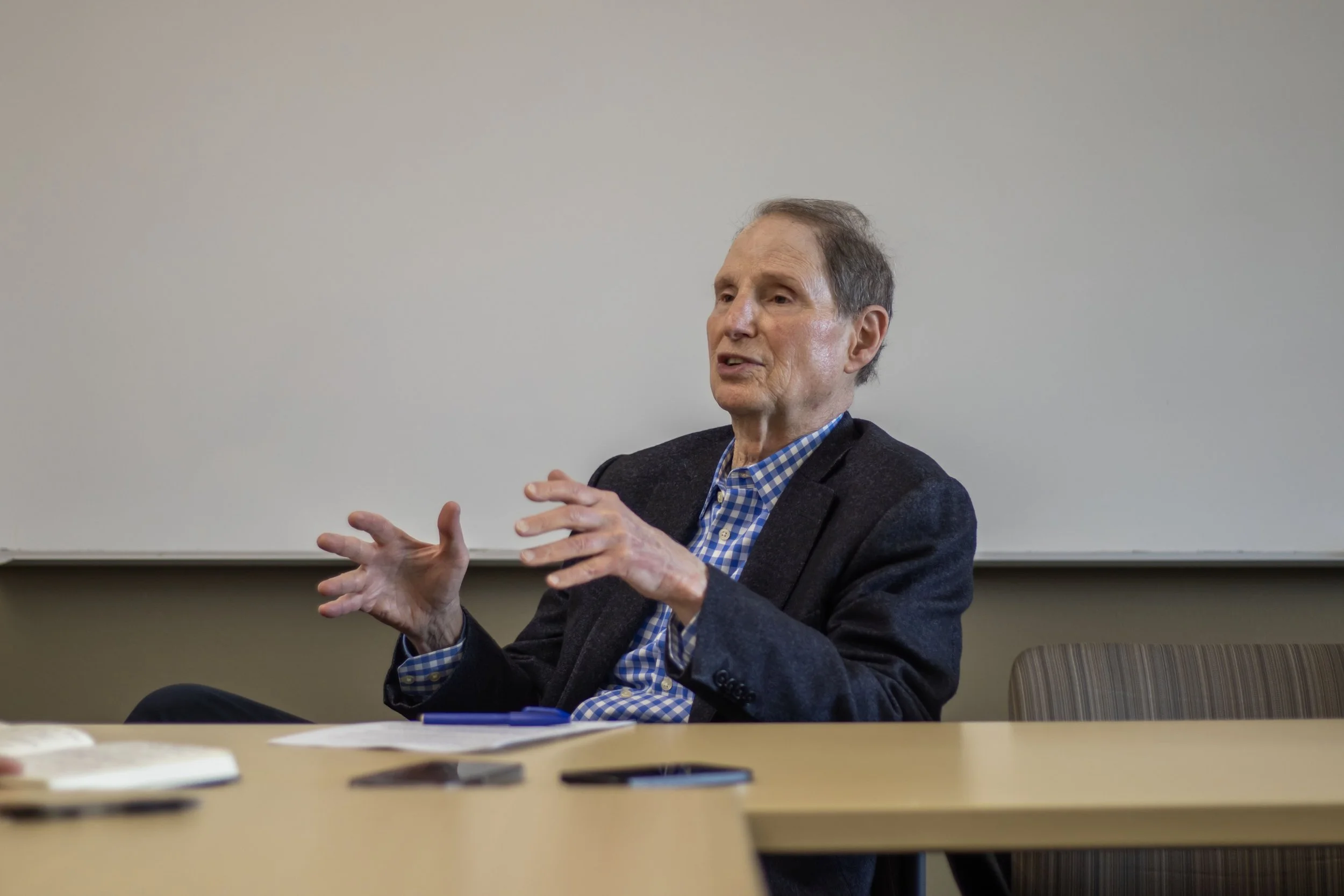
a q/a WITH rON wyden
Interviewer & Writer McKenzee Manlupig
Photographer Alyssa Garcia
Web Designer Alexandra Bondurant
Ron Wyden has been serving as a Democratic senator for Oregon since 1996. He served in the U.S. House of Representatives from 1981 – 1996. He sat down with Flux to talk about economic opportunity, federal spending and youth leadership.

Manlupig:
There’s a lot of anxiety among young people about wages not keeping up with costs. What policies do you think would make the most immediate difference?
Wyden:
There are safety net policies — unemployment insurance and things like that — but I think the major thing is to make it possible for people to get those high-skill, high-wage jobs. Sometimes they’re in technology, sometimes they’re in health care, sometimes they’re in communications. What I’ve tried to do is support all of those fields where it increases the number of constructive choices for students and families.
Manlupig:
How do issues like economic opportunity for young people intersect with broader policy areas like privacy and technology regulation?
Wyden:
Employers are going to be receptive to people who are coming out of college well-trained. For example, if you know a language, if you’ve done some work in technology, and like, you go in with a leg up. And that’s why I support all those measures that ensure that there’s adequate financing for students, rather than what Donald Trump is trying to do, which is to destroy higher ed.
Manlupig:
Speaking of funding for students, I saw that you recently helped secure nearly $100 million for Oregon rural schools after the Secure Rural Schools Program lapsed for almost two years.
Wyden:
The Secure Rural Schools Act is bringing Oregon $3.5 billion in funding. Historically, Oregon schools would get a big chunk of money from the federal government tied to cutting timber on federal land. So when the environmental laws changed, we weren’t getting that money.
I wrote the law that brought us the money so that we wouldn’t have schools three days a week in Oregon, and we just got another installment. In terms of what I’ve done as a public official, this is one of the more important ones because this is a very serious authorization of funds for schools and law enforcement and roads in rural areas.
Manlupig:
Nationally, Education Week reported that the Trump administration has disrupted at least $12 billion in K-12 funding in its first year. Are we reaching a point where Congress is constantly backfilling crises instead of providing stable funding schools can actually plan around?
Wyden:
I’d like it to be the latter — to have stable funding that schools can plan around right now. We don’t have the Republican votes. Senators are going home right now, and I hope that they start seeing that their constituents are pretty damn angry.
Manlupig:
Have you heard from your constituents about this?
Wyden:
Huge. I mean, it comes up everywhere. Particularly in Oregon, for working-class families, people want the chance to get their skills, like you said, to be in a position to get a good-paying job, and they ought to have some choices in terms of education and communications and science and math and all the various fields to do it.
Manlupig:
Do you know, at what point does backfilling stop being sustainable?
Wyden:
Backfilling is taking the place of stable funding. Stable funding [is what] should be done because spending all the money on the war in Iran is silly. It’s a war of choice. It’s not giving us value, and we ought to take some of those resources and plow them into education and priorities for communities.
Manlupig:
So you bring decades of experience, but at the same time, some voters are asking whether leadership should make more room for younger generations. What do you think about balancing experience with generational turnover?
Wyden:
I think a couple of things. First, I do everything I can to attract more young people to government and to politics. When I have my town hall meetings, I try to have half the room high school students and half the room community leaders. And we call it “Listening to The Future.” And if a high school student makes a point or something that they’re really interested in, I offer them an internship in my office on the spot.
What do we want in government? We want people with the energy and the ideas and the drive. Some of them might be 21 and some of them might be three times that age, and I think that’s why we have elections. And I’m the first United States senator ever elected by mail, and I’m very proud of that, because that was a big innovation.