

A northwestern tribe revives culture as surrounding landscapes deteriorate
People
River
Of the
Writers Leo Brown, Ian Valleau Photographer Heronima Valledor Web Designer Alexandra Bondurant
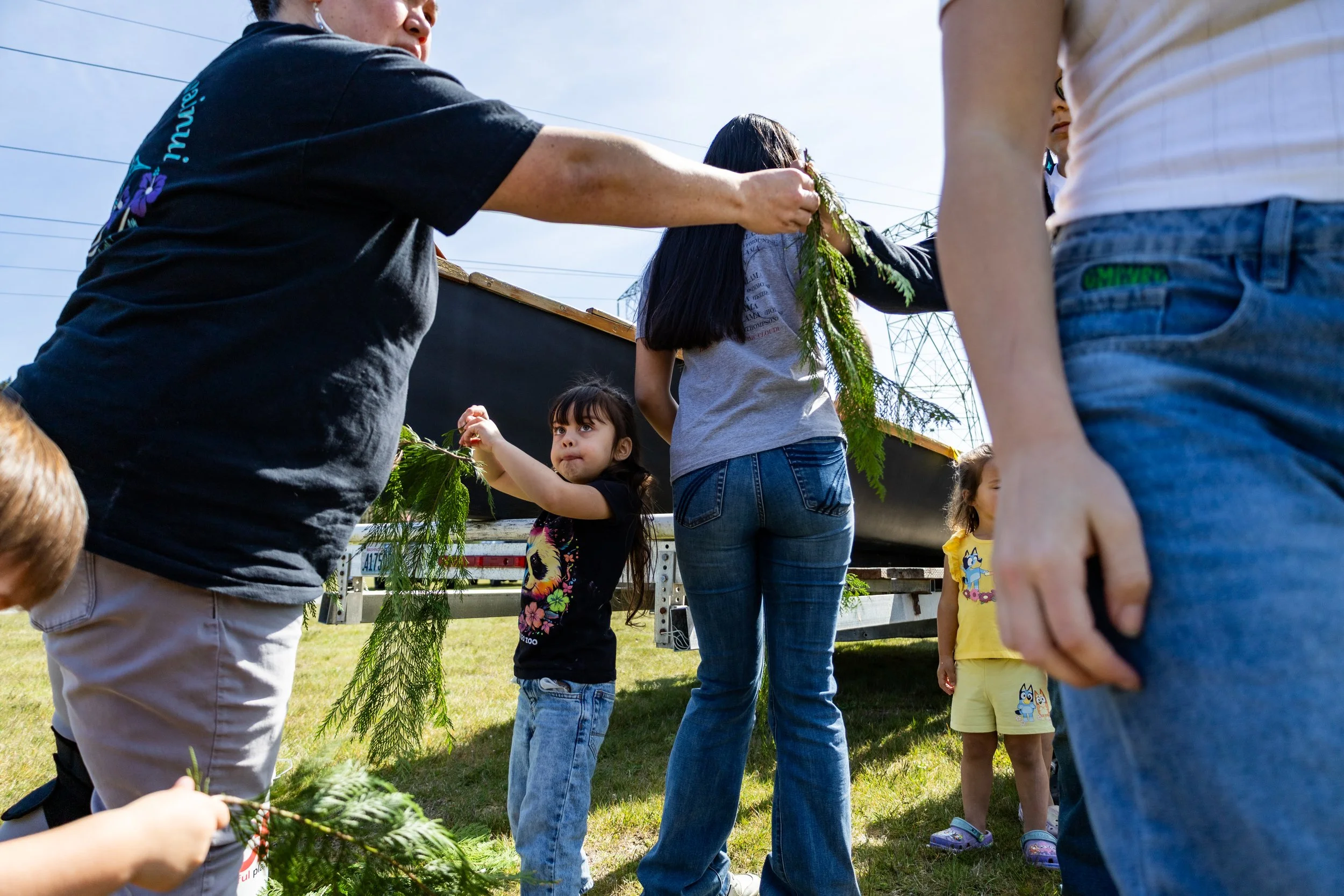
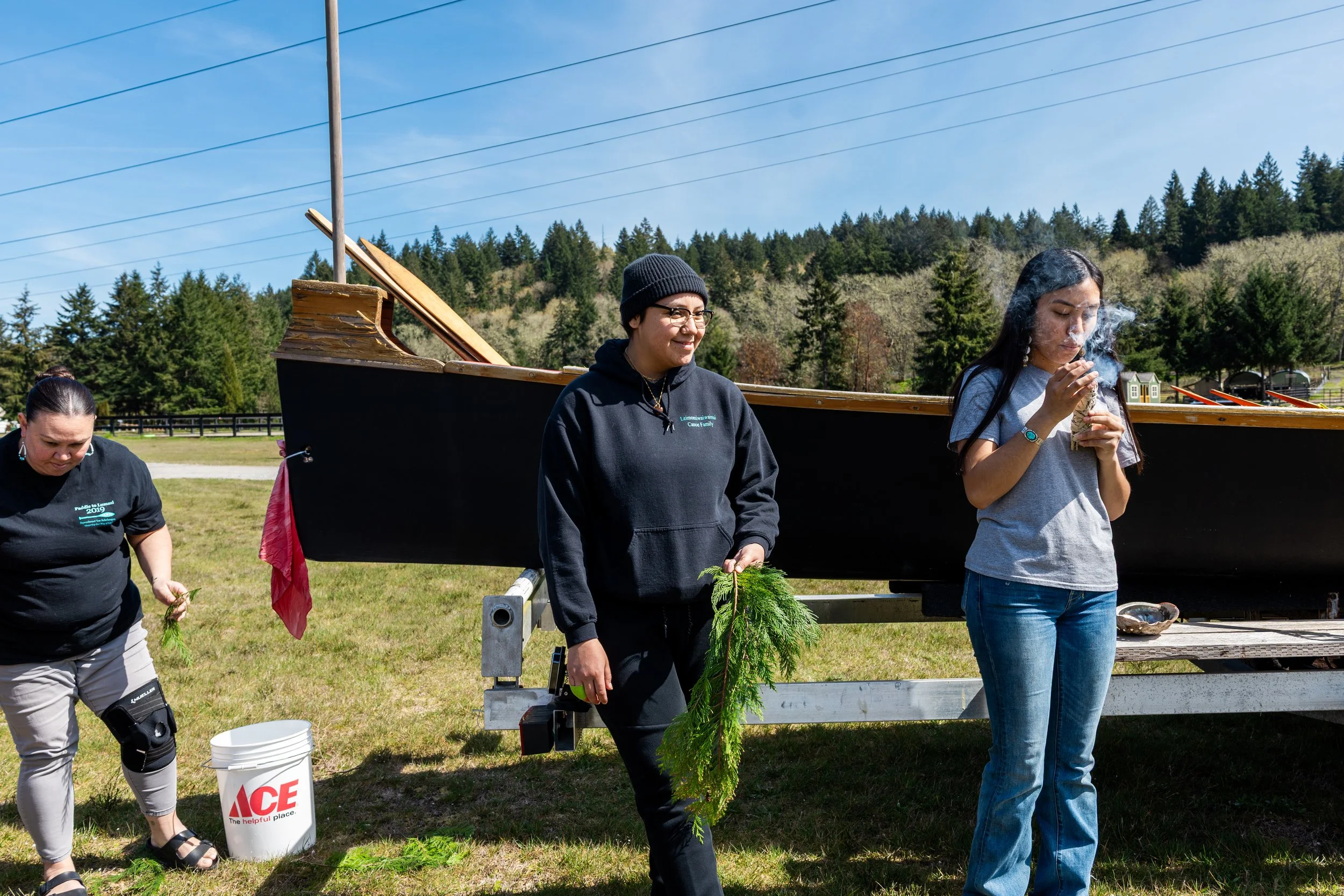
Mehanna McCloud, 16, and her mom, Iwalani McCloud, 40, help the children, including Amitola McCloud Sanchez, 3, pass around cedar stems in preparation for blessing and reawakening the canoe. Mehana McCloud kindles a bundle of sage until smoke billows from the apex. As the ceremony begins, a huddle of tribal members strike their hand drums.
From within, McCloud vocalizes an old Nisqually tune, signaling the “awakening” of the canoes.
She circles her family’s canoe, brushing the dark smoke over the helm, letting the haze envelop the entire vessel. Following her, a group of Nisqually, both young and old, dip cedar boughs into a bucket of Nisqually River water.
One by one, following McCloud, they paint the hull with water.
Golden rays shimmer on the grass of Medicine Horse Ranch. Spring has returned to the Nisqually Reservation.
Each spring, the McClouds, like other Nisqually families, awaken their canoe after a long rest. The past few years, however, have felt different. The river’s source is drying up.
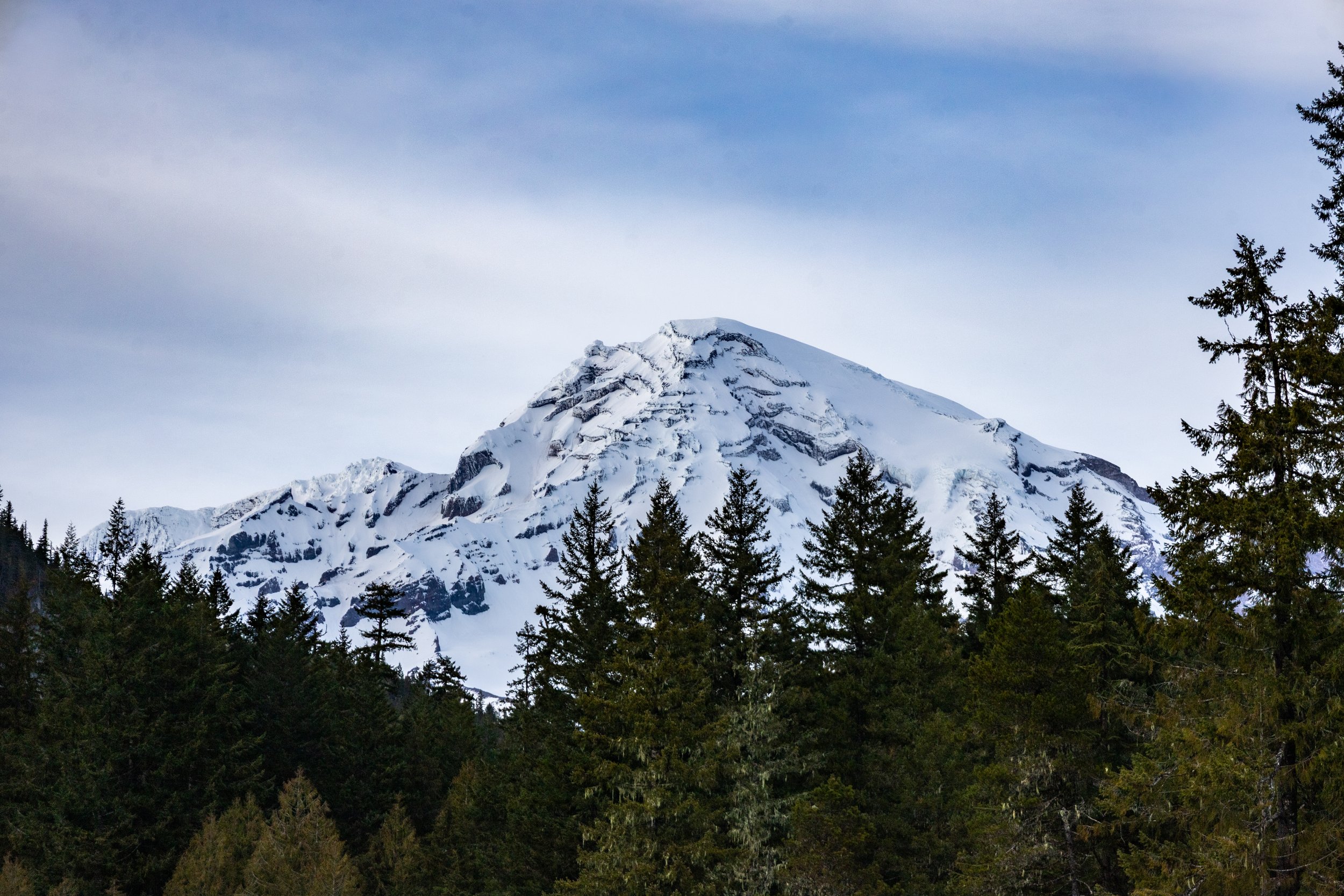
A winter with little snow has left Mount Rainier malnourished, threatening vital Nisqually customs.
The early Nisqually migrated north from the Great Plains 10,000 years ago and established themselves on the Nisqually River watershed. Since then, they have coexisted with the land surrounding Mount Rainier. The mountain, known to the tribe as Tahoma, is the “mother of waters.”
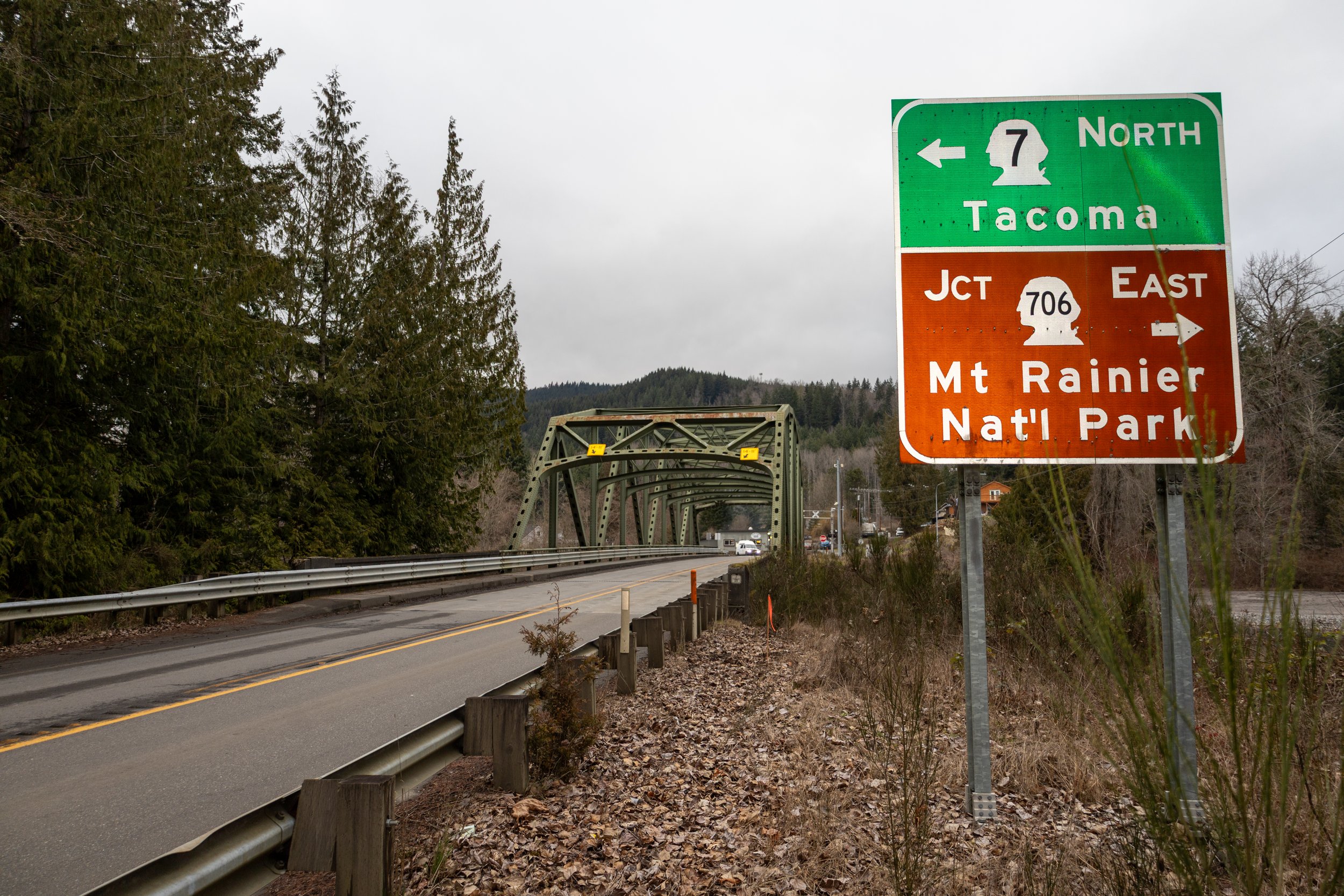
A bridge crosses the Nisqually River, leading toward Mount Rainier.
-
![]()
Jocelyn C. Squally, 16, and her dad, Willie Squally, 53, are members of the Medicine River Ranch Group, a Nisqually horse therapy program that began around three years ago. They are doing tricks atop the horses, back and forth in a friendly competition, while they wait for the Leschi Honor Walk to commence.
-
![]()
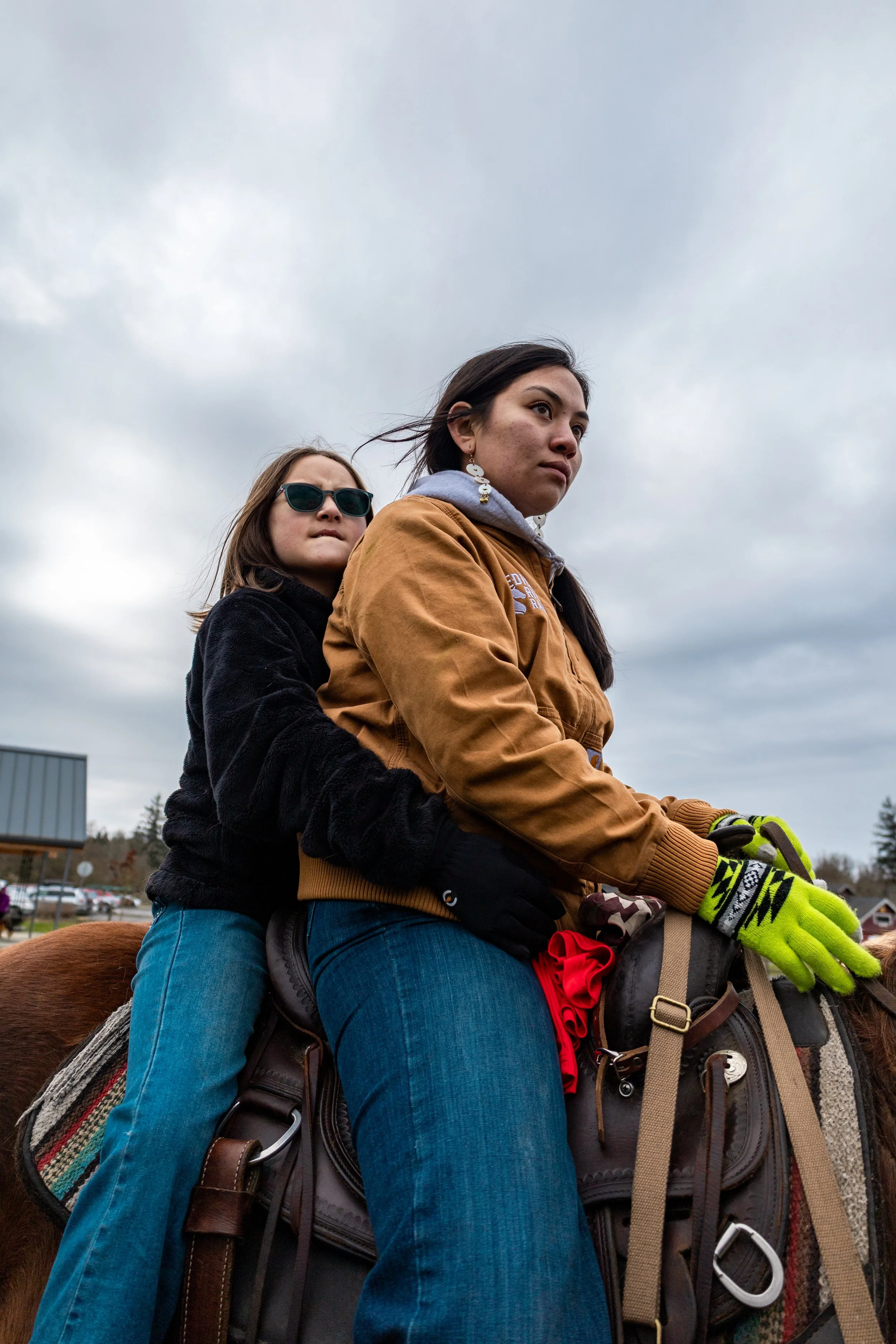
The youth leader of Medicine River Ranch, Mehana McCloud, 16, sits on her horse while a young rider, Qwulishubulh Bob, 9, holds on to her, quietly listening to the elders speak and sing. Soon after, McCloud herself is unexpectedly called up to speak. She is overwhelmed by emotion, breaking into tears while Bob quietly comforts her.
-
![]()
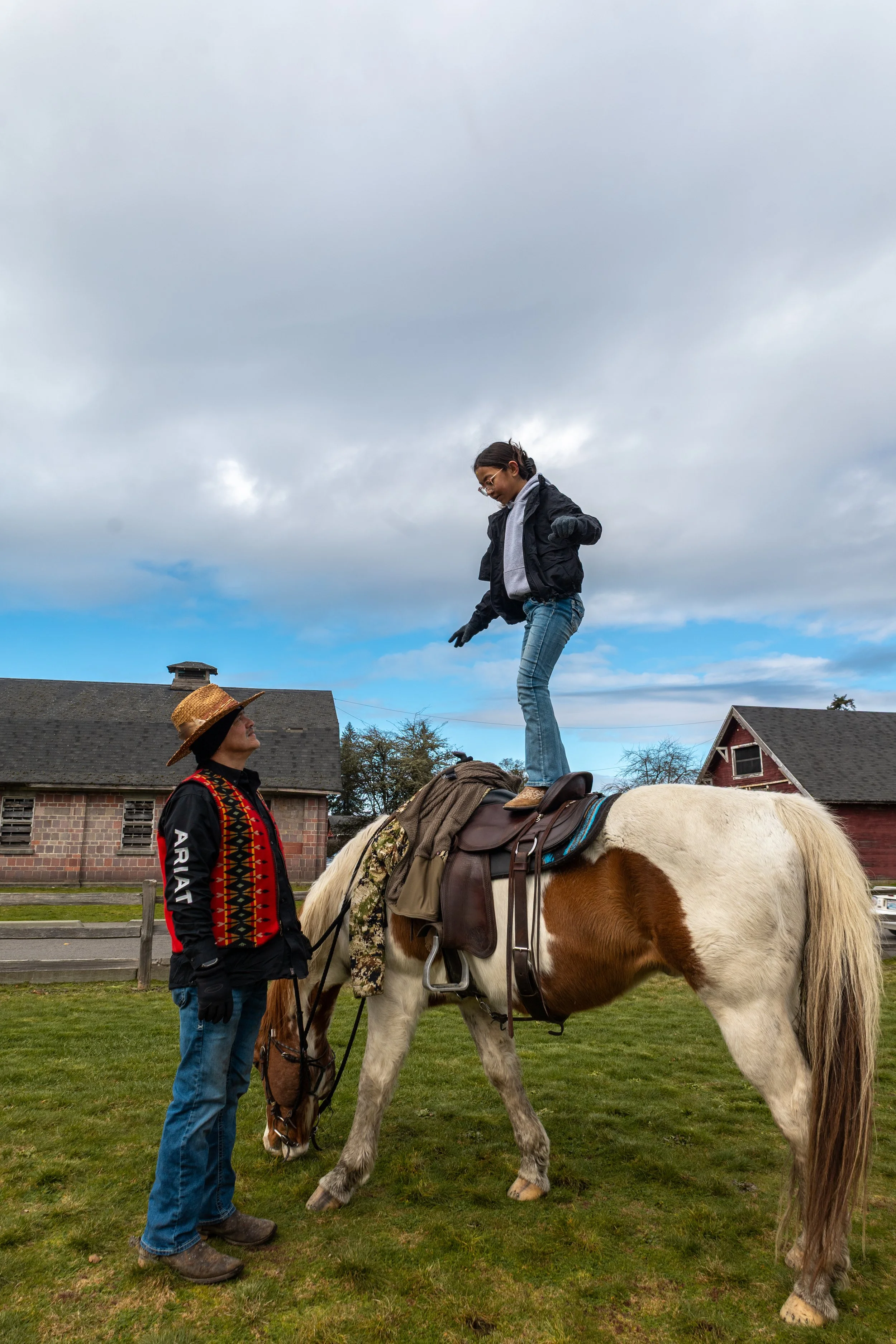
After the Leschi Honor Walk, everyone gathers to hang out, relax and enjoy various foods and games. Willie Squally, 53, is supervising Ila’lani McCloud, 10, while she attempts to stand up on a horse.
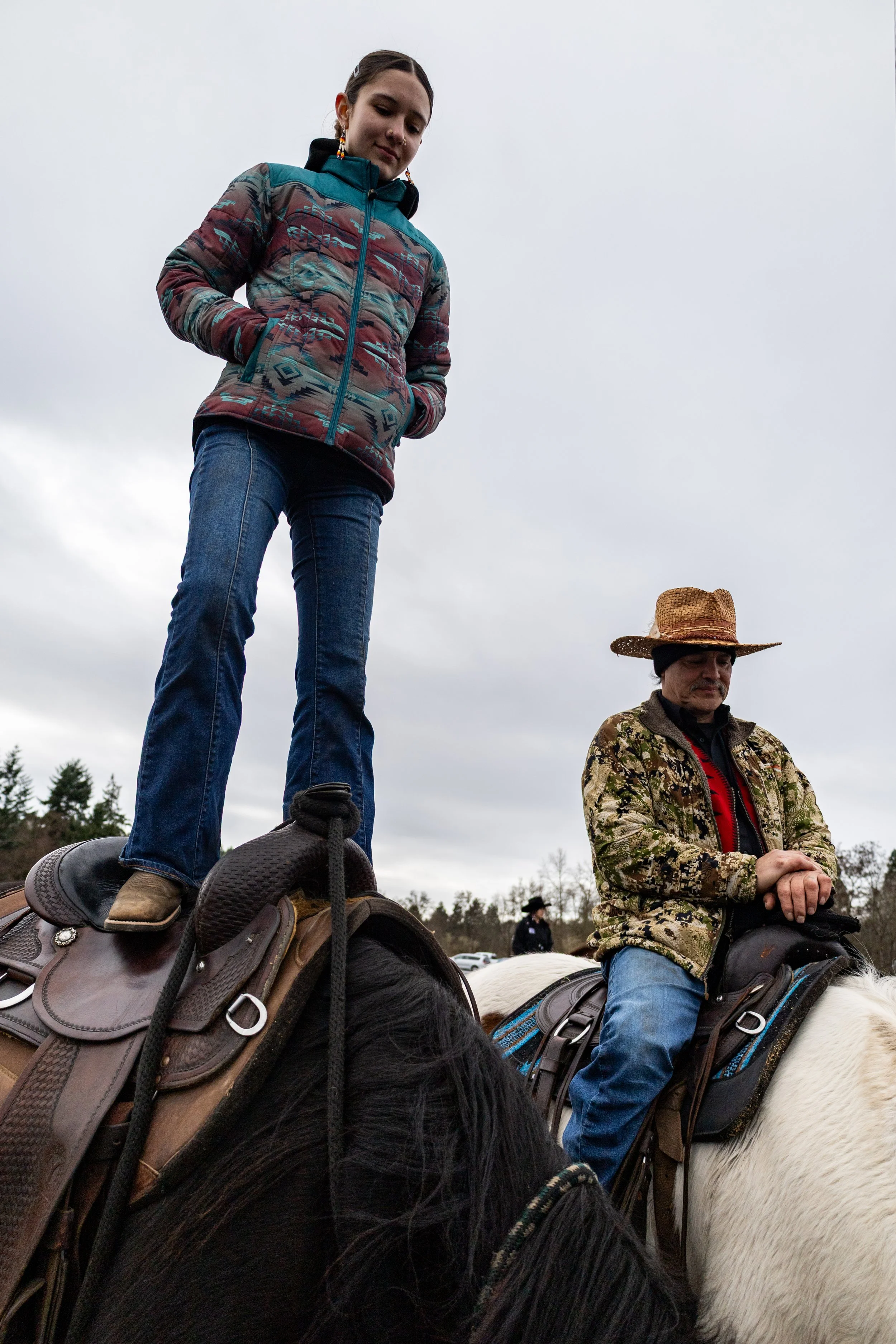
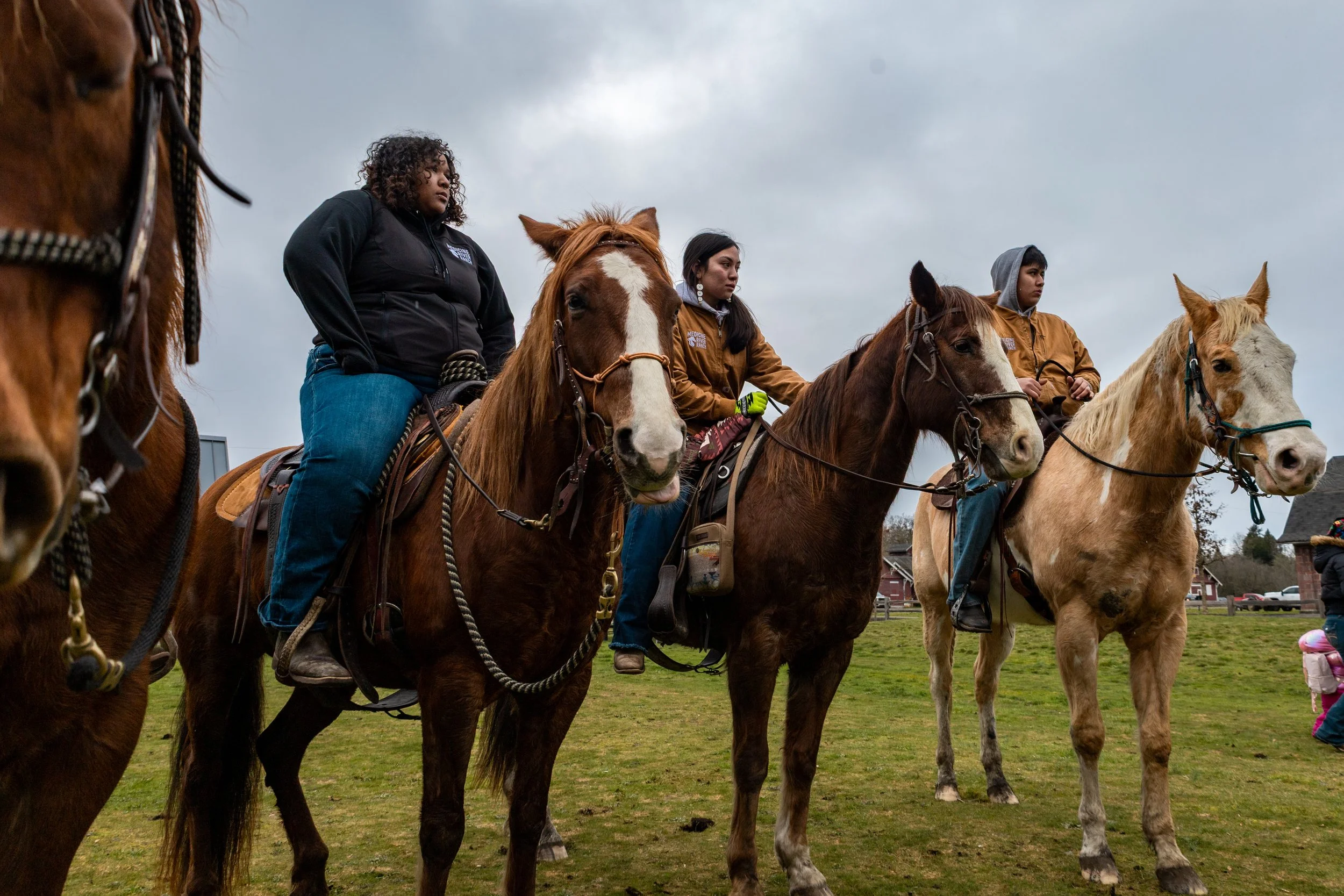
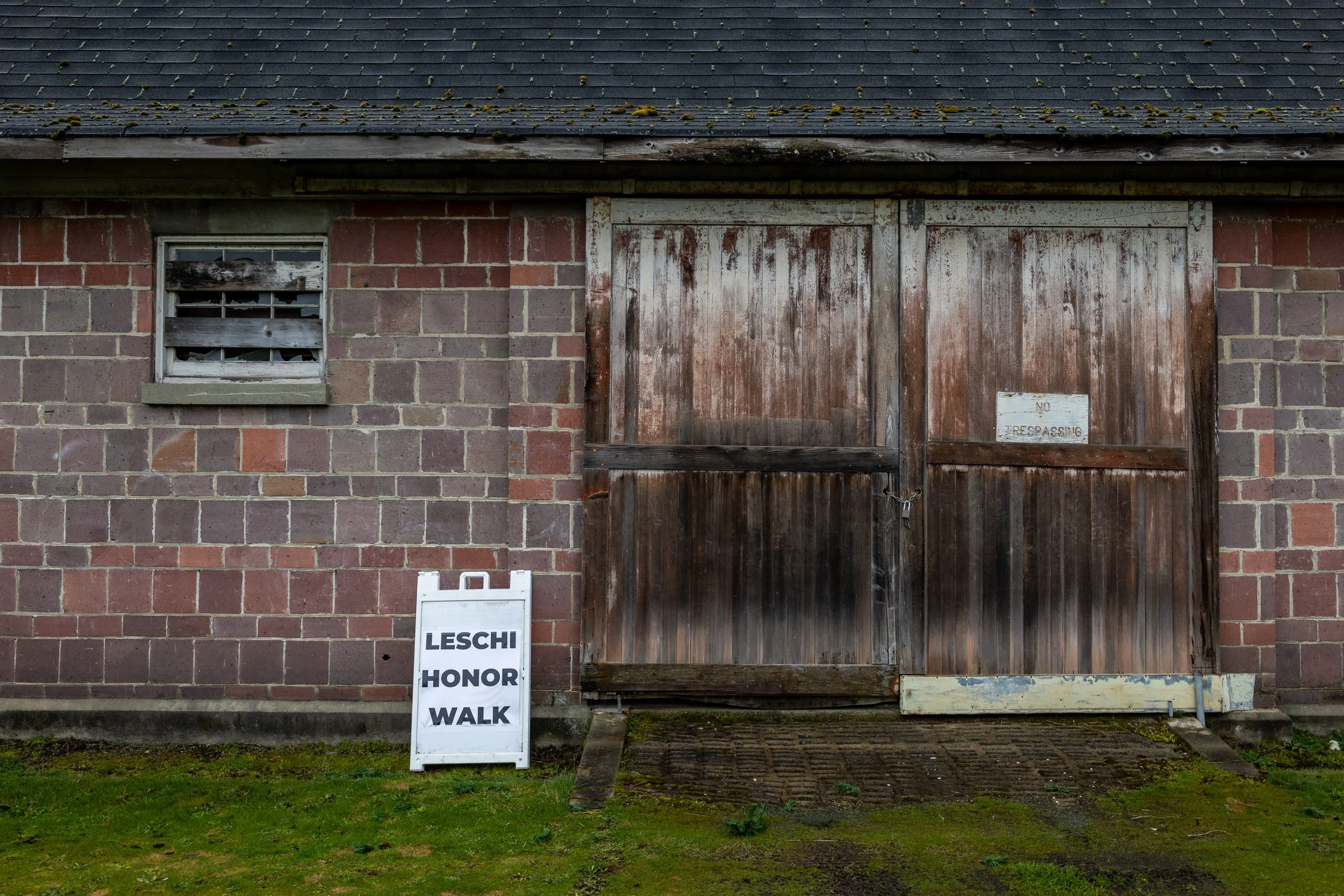
The younger generation, from left, Annie Hicks, 16, Mehana McCloud, 16, and Nino Arellano Villegas, 13, sit on their horses, listening to the elders while the snow falls. They prepare to begin the Chief Leschi Honor Walk around Fort Steilacoom Park in Lakewood, Wash.
Centuries of reservation treaties, fishing regulations and Federal Indian boarding schools stripped the Nisqually of their traditions. Now, the tribe wants to reconnect with its ancestral roots, but the land can’t travel back in time.
The sudden and intense transformations from climate change have scarred the terrain. The Nisqually are left to chase their heritage — hunting, fishing and healing on lands that are being reshaped before their eyes.
The Nisqually are known as “people of the river, people of the grass.”
They’ve customarily fished the abundant salmon runs throughout the Nisqually River. Salmon served as their primary food source, along with shellfish gathered at the mushy estuary bed of the southern Puget Sound.
Some tribal elders recount a time when salmon runs were so abundant they could practically walk across the river on their backs.
Runoff from Mount Rainier sustains the rich populations. The mountain, which governs the surrounding land and overlooks the reservation, has nourished the Nisqually River for eons.
The Nisqually fishermen scoop salmon on the fish’s natal return, using hemp twined nets attached to pliant green branches. The nets allow them to selectively harvest, keeping what they need while ensuring healthy new generations of salmon return, according to the Columbia River Inter-Tribal Commission.
Towering 14,000 feet and blanketed in a glacial shield, the mother of waters holds five to seven trillion pounds of ice or perennial snow as of 2021, according to a National Park Service report. She bears more ice than all other glaciated peaks in the contiguous United States, according to the United States Geological Survey.
The Nisqually glacier is a 3.5-mile-long ice sheet that ascends 9,000 feet up Mount Rainier. The toe of the glacier shelters beneath the timberline. The head nearly kisses the summit.
Its runoff feeds the Nisqually River. Zigzagging 90 miles from the southern slope of Mount Rainier to Puget Sound, the river is a hub of biodiversity.
Tribal elders say Mount Rainier was in the Olympic Mountain Range 2 million years ago. It was too crowded, so she moved. Her path carved a deep valley, now known as Puget Sound. As she was leaving, she told her son, a peak on the eastern side of the mountain, “Don’t forget the water.”
Their journey created the lands and river that the Nisqually became synonymous with. For millennia, they tended to the land that supported them.
Around 30 years after settlers arrived in the area, the United States government and nine indigenous tribes signed the 1854 Medicine Creek Treaty, which forced the tribes to cede approximately 2 million acres and limit their fishing rights to the reservation.
The treaty sparked the Puget Sound War from 1855 to 1856. A coalition of Cascadian tribes, led by Chief Leschi of the Nisqually, fought against U.S. troops.
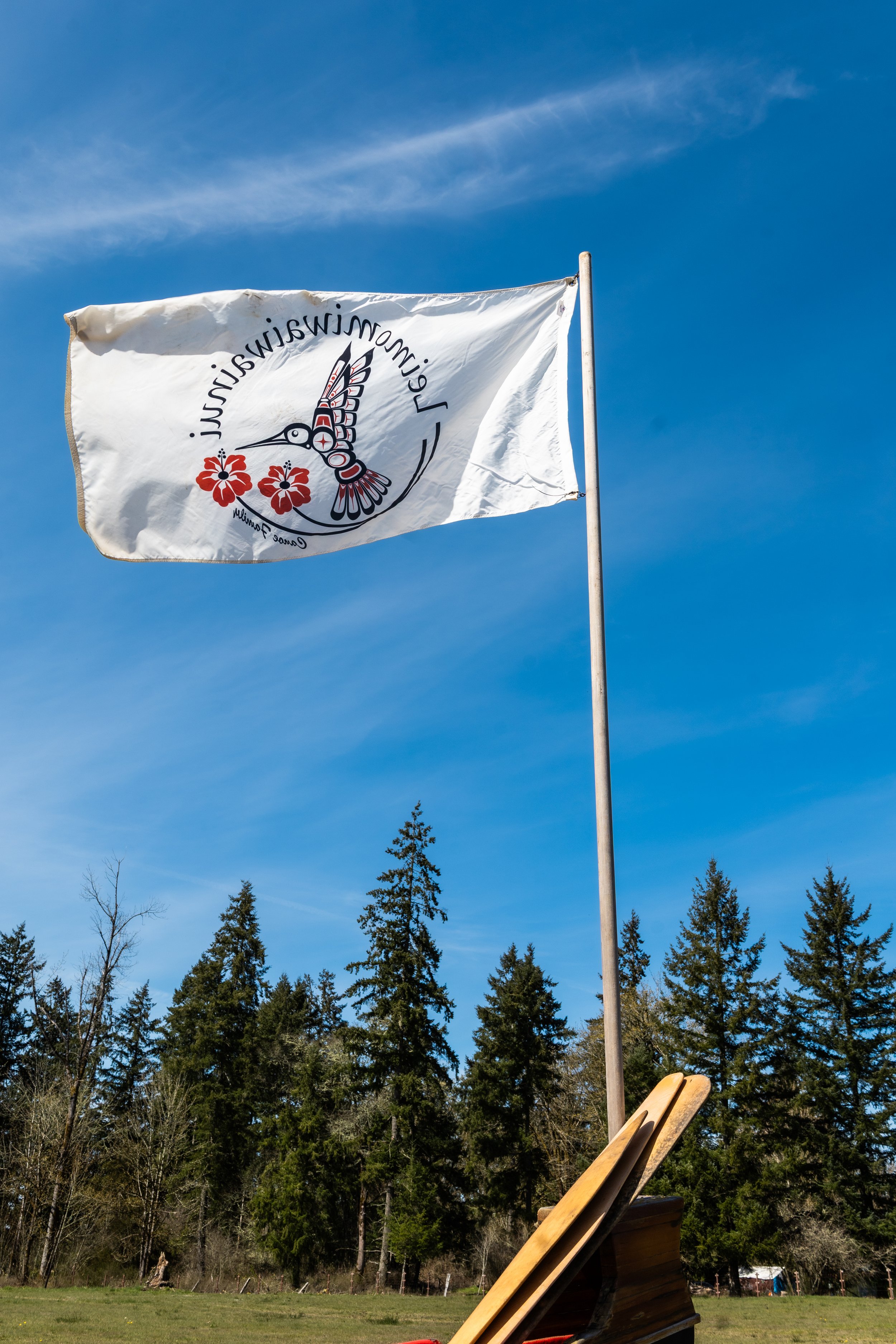
The Leimomiwaiwaini flag flies above the canoe before it is soon reawakened for the summer season. The flag shows this family’s symbol, the hummingbird, which represents beauty within the Nisqually culture.
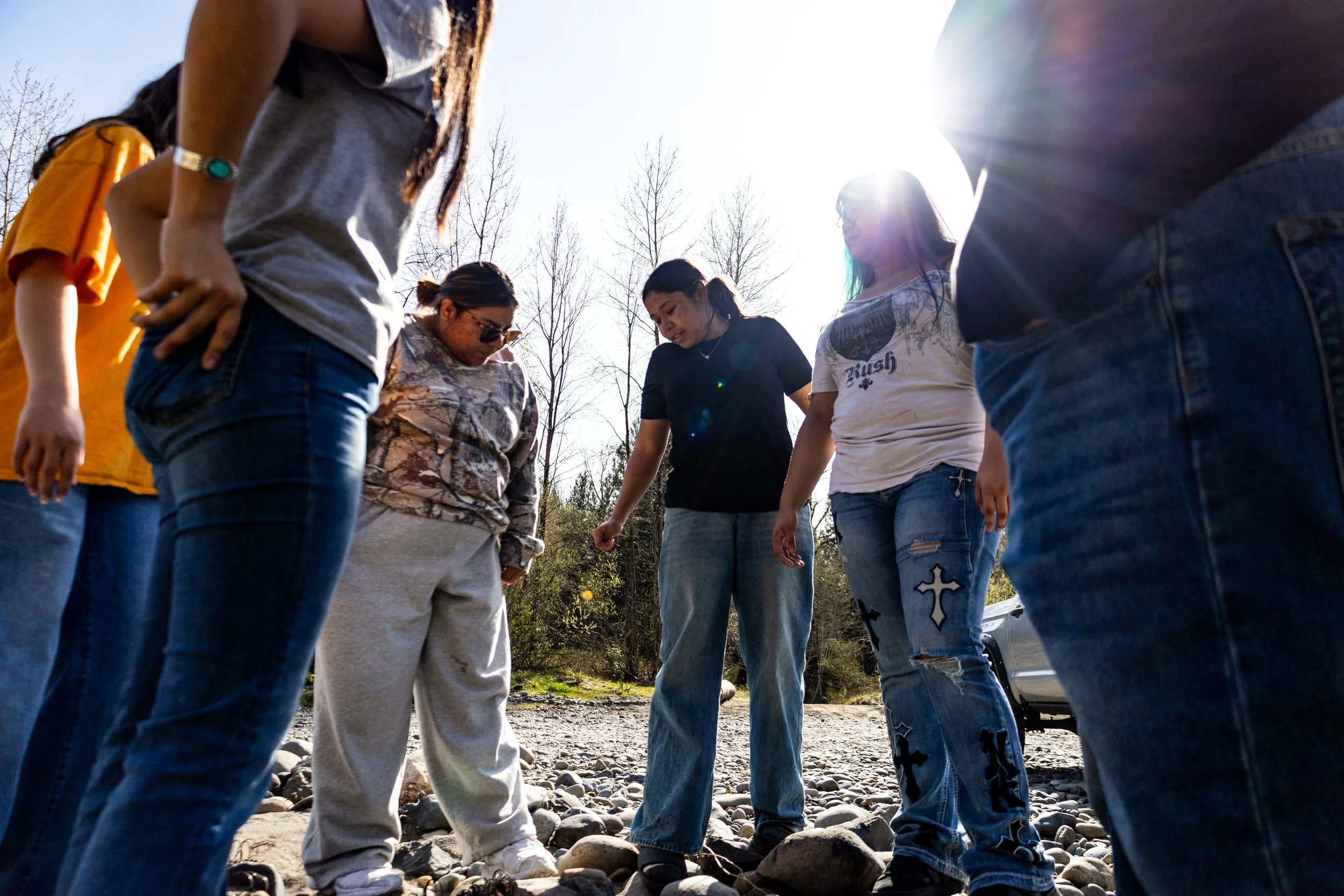
After the reawakening ceremony, the teenagers are sent to toss the cedar branches into the Nisqually River, east of the Puget Sound. Mehanna McCloud, 16, leads them while they each say a prayer and hang out along the shore of the Nisqually.
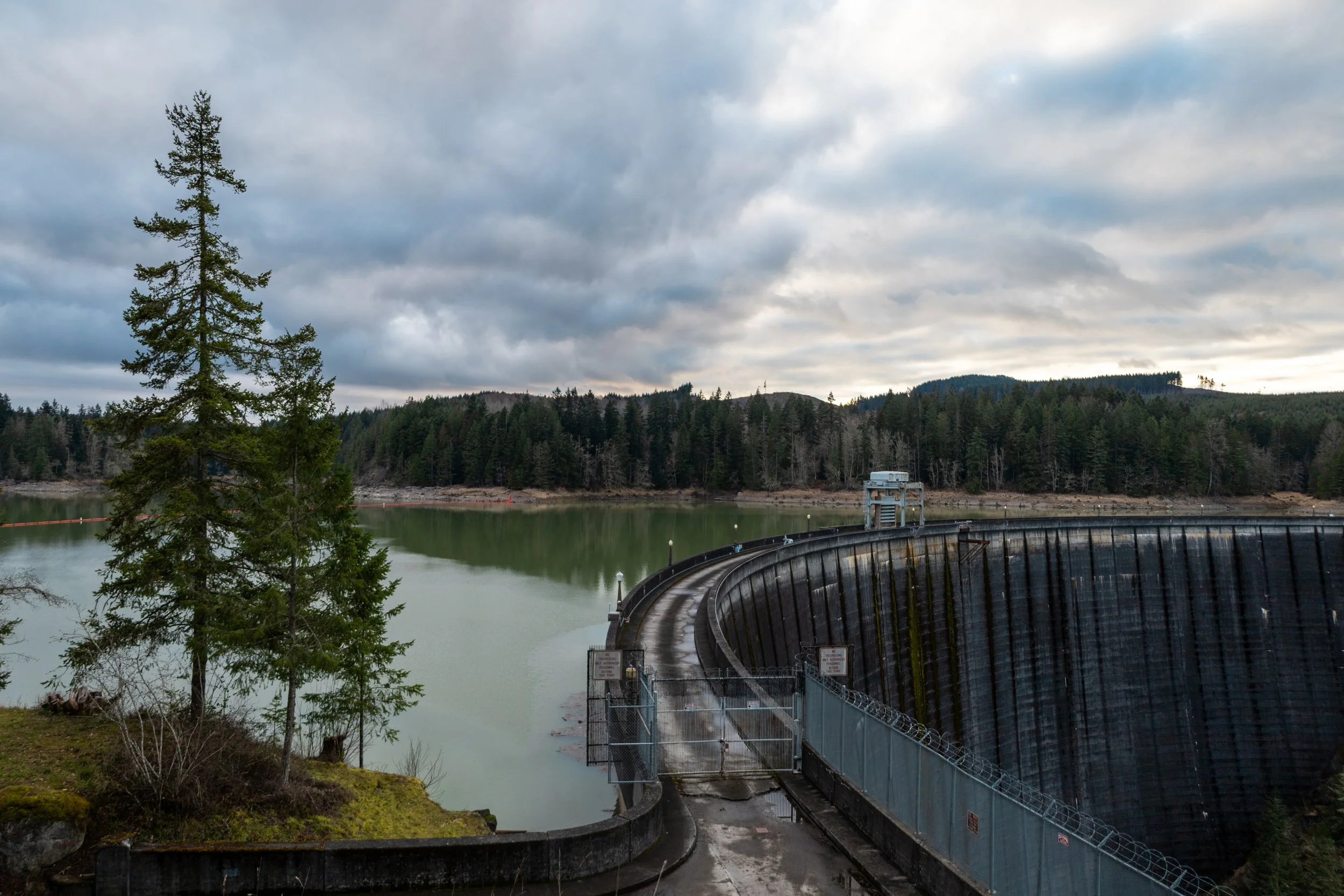
The Nisqually River feeds into Alder Lake and meets the Alder Dam.
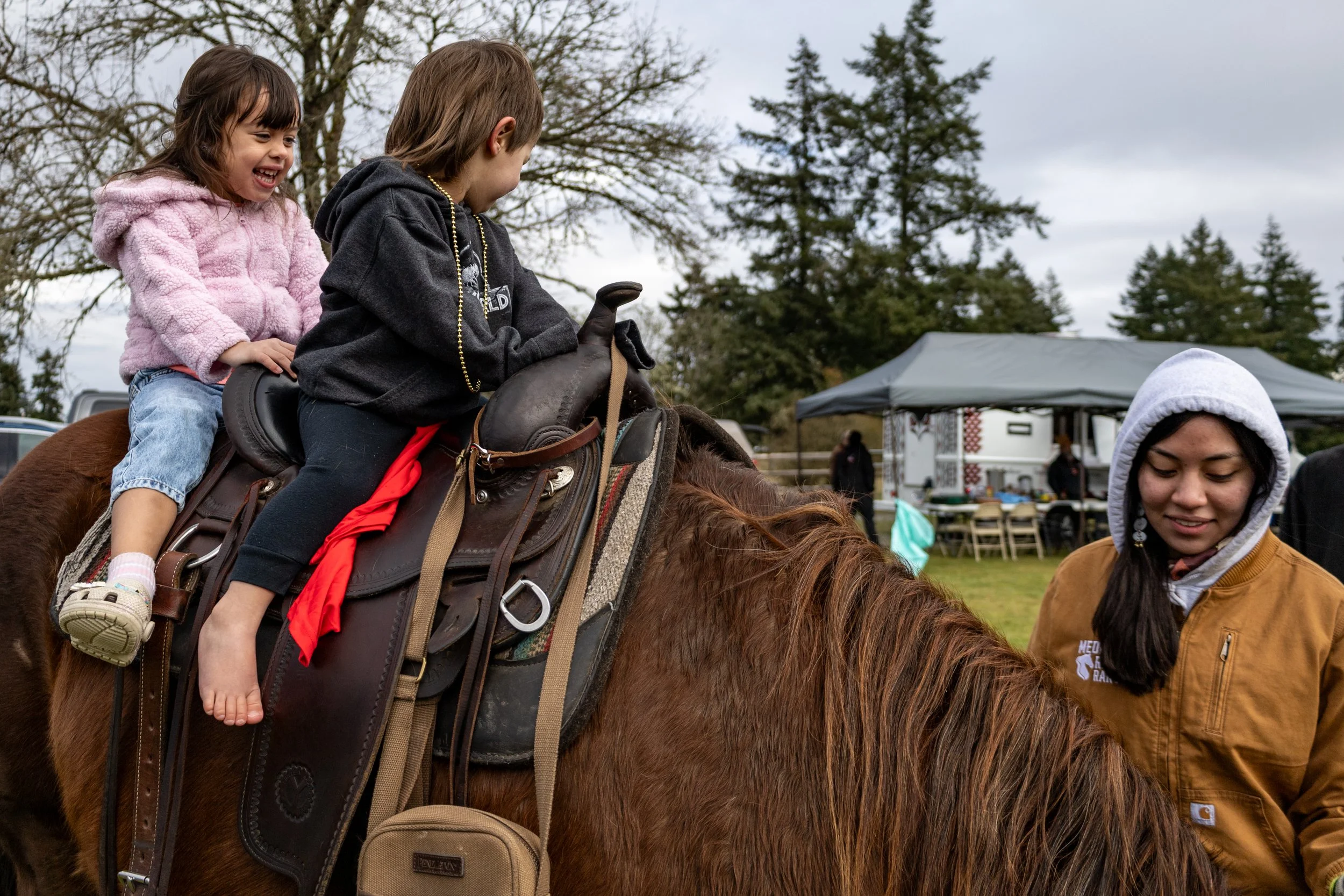
After the Leschi walk ended, two visiting children, Amitola McCloud Sanchez, 3, and Raymond McCloud Sanchez, 2, sat on one of the horses while Mehana supervised them.-
![]()
On February 19, 2026, the annual Leschi Honor Walk took place in Fort Steilacoom Park, the largest park in Lakewood, Wash. The tribe gathers to pay their respects to the late Chief Leschi and reconnect with their lands.
-
![]()
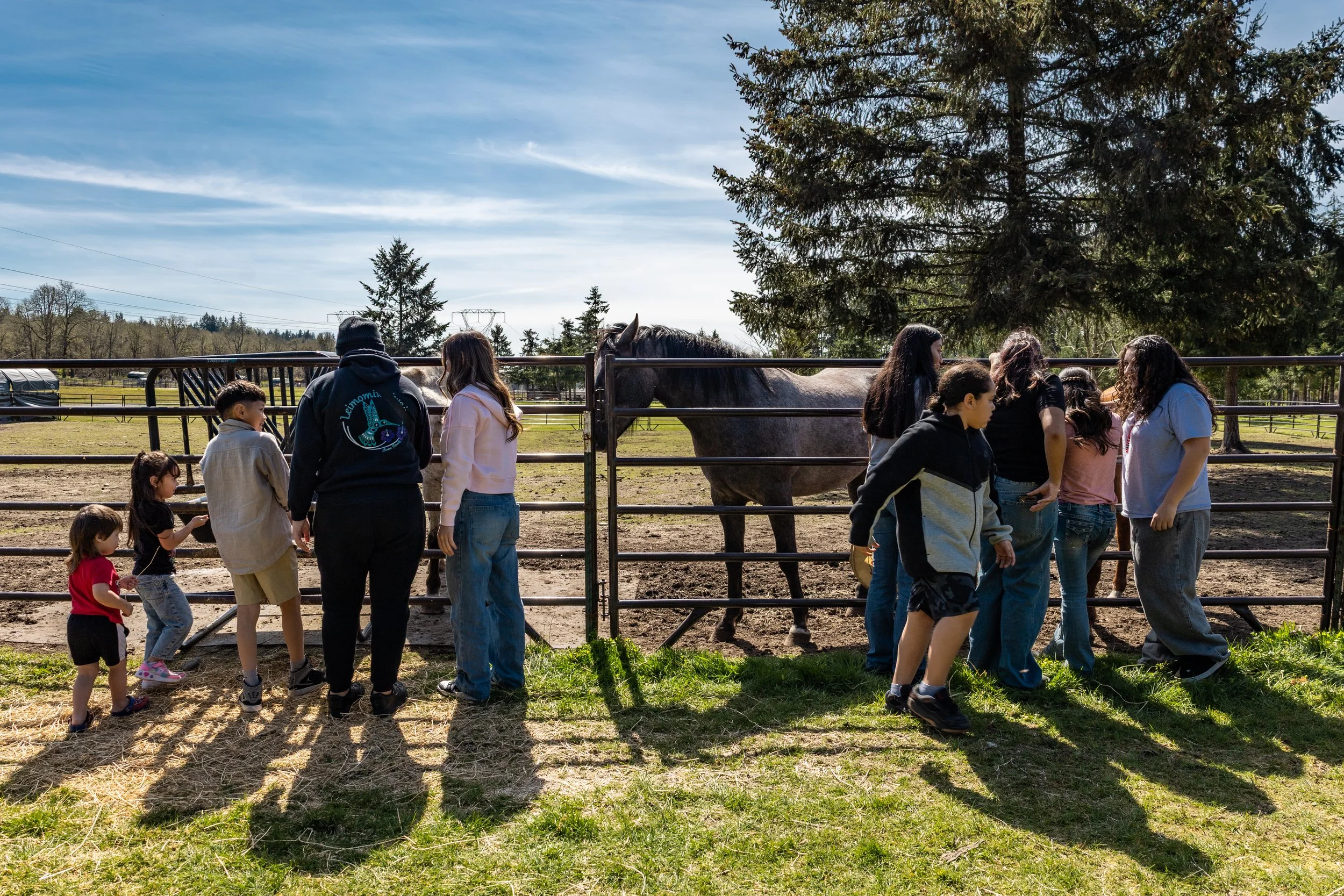
The younger generation of the Nisqually Tribe gathers around the horses at Medicine River Ranch before being called to begin the canoe reawakening ceremony.
-
![]()
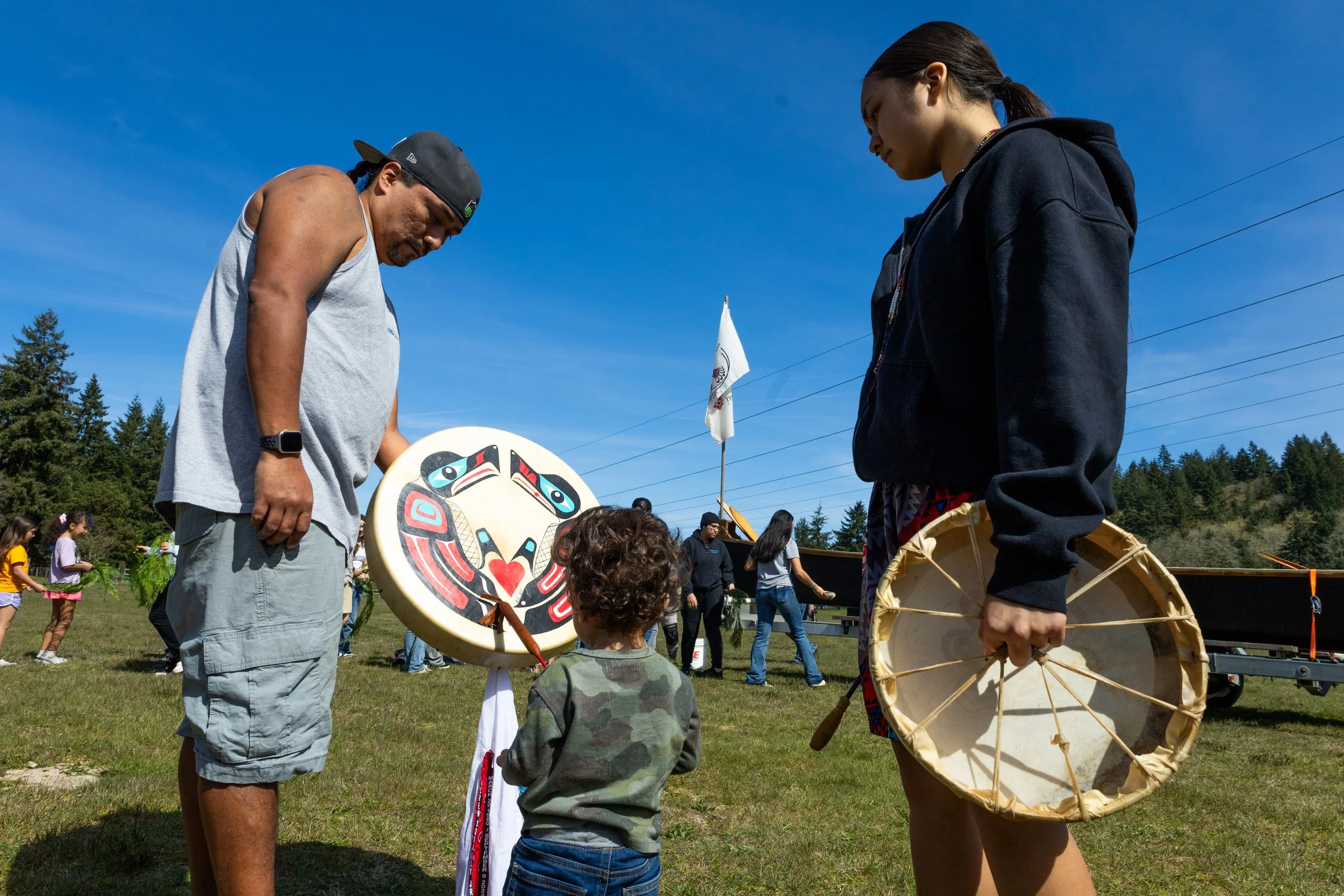
Kyle Sanchez, 40, and Sky’Lene, 14, allow Salhal Sanchez, 2, to play around with the ceremonial drums, which, within the tribe’s culture, are meant to represent the beat of Mother Earth’s heart.
-
![]()
Youth Leader at Medicine River Ranch, Mehanna McCCloud,16, burns sage alongside her cousin Nalani Brisbois, 27. They prepare to cover the canoe with cedar and incense and begin the reawakening process to prepare the boat for their annual summer canoe journey.
-
![]()
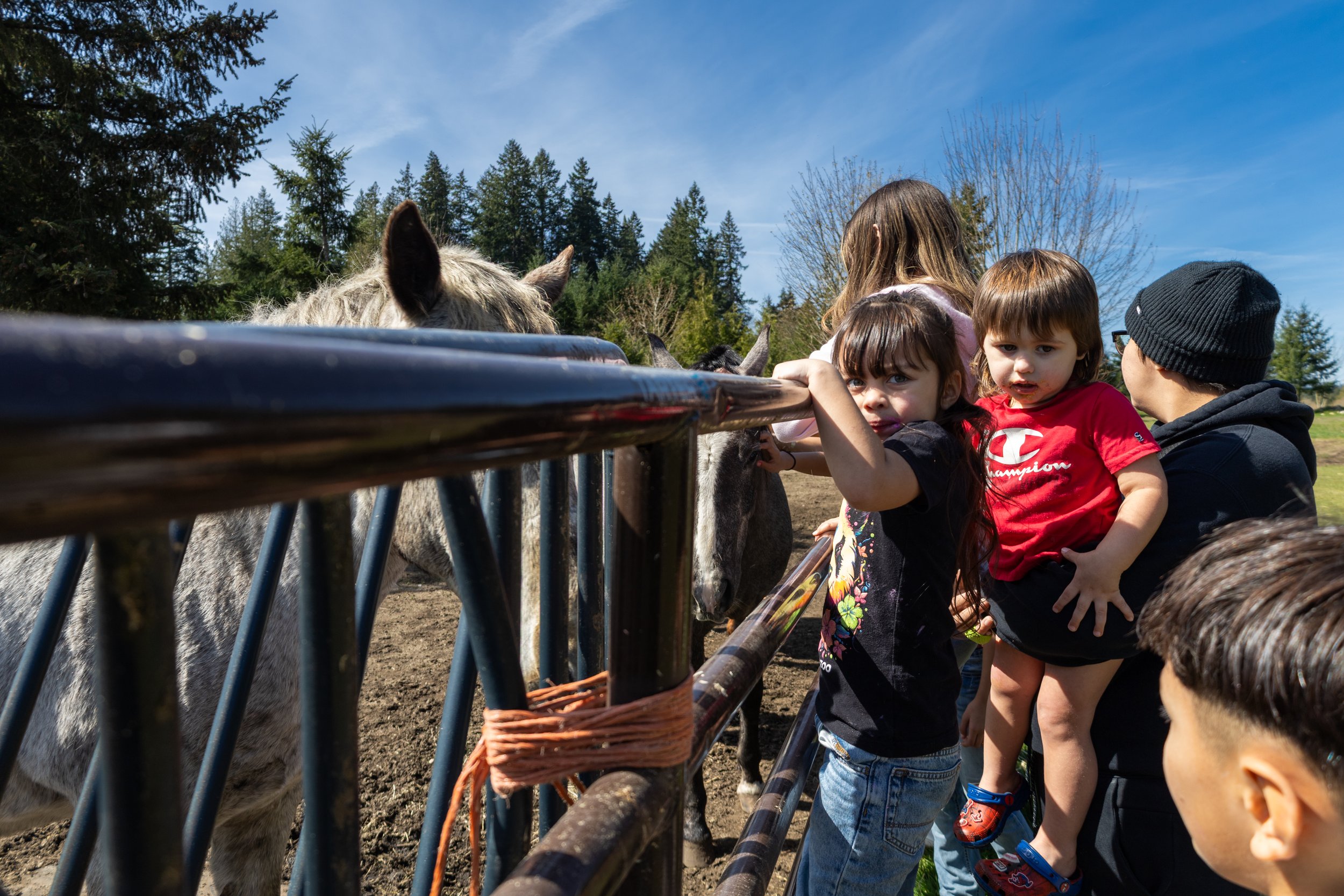
On April 4, 2026, before the canoe reawakening ceremony hosted at Medicine River Ranch, two visiting children, Amitola McCloud Sanchez, 3, and Raymond McCloud Sanchez, 2, play with the horses while the older kids hold them up.
After the fighting, Chief Leschi was hanged — the final act of a brutal conflict.
Following Leschi’s execution, the Nisqually people were forced to abandon their culture, traditions and native language, Lushootseed. Federal Indian boarding schools would beat, starve and cut the hair of young indigenous Americans in an attempt to erase their identity.
In the early 1860s, Nisqually culture went into hibernation, hunkered down in undersized reservations.
“They tried to terminate us,” Willie Frank III, director of the Wa He Lut Indian School, said. “They tried to literally take away everything that we have, and we’re still here today, and we still have those teachings.”
Frank III gazes over the Nisqually River in the same spot his father was arrested more than 50 times. At this section of the river, the glassy water eddies and murmurs over logs jetting from the river bed. Frank III is waiting until the cottonwood trees bloom and fluffy seeds settle on the surface of the river, signaling warm weather and the start of the fishing season.
Every August, Frank III, using time-honored techniques, stretches L-shaped nets from the stern of his boat to riparian trees. The boat drifts to an idling position in the middle of the river. The anchored nets catch salmon on their way back from the ocean.
“It’’s like going to church for us as Indian people,” Frank III said. While others practice their faith on Sundays, the Frank lineage has taken theirs to the water. “I was able to fish with my dad and my brothers. Generations, all fishing together.”
Frank III has been fishing for 25 years. He grew up on Frank’s Landing, a spot on the Nisqually River named after his late father, Billy Frank Jr., who secured fishing rights for the tribe in the 1970s.
Frank Jr. was one of the first to reawaken Nisqually culture after years of hibernation. As an activist, he was arrested for fishing on his own property downstream from the Nisqually reservation. With each arrest, his legend grew.
His actions and outspoken beliefs garnered national attention, sparking the Fish Wars in the 1960s, where Washington tribes battled fishing regulations on and off the river for more than a decade.
Billy Frank Jr.’s commitment was a driving force in the landmark 1974 Boldt Decision. The ruling reclaimed Washington State tribes’ fishing rights and allowed them 50% of the annual harvest.
This battle was about more than fish. It was about keeping Nisqually culture alive.
“[That mountain] gives us life,” Frank III said. “My dad used to say, ‘If the salmon are healthy, we as human beings are healthy, because we know our water’s clean. You know our air’s clean. You know that that mountain is healthy.’”
The lush salmon populations in the Nisqually River thrive in the shade of Mount Rainier. The temperate climate means glaciers melt, freeze, creak, ooze and crack with the season; almost like they’re alive. Spring melt cools the water and provides nutrients for salmon to spawn, migrate and survive.
These glaciers must have a reliable snowpack to offset the summer melt. It allows them to maintain their mass throughout the cycle of frost and thaw.
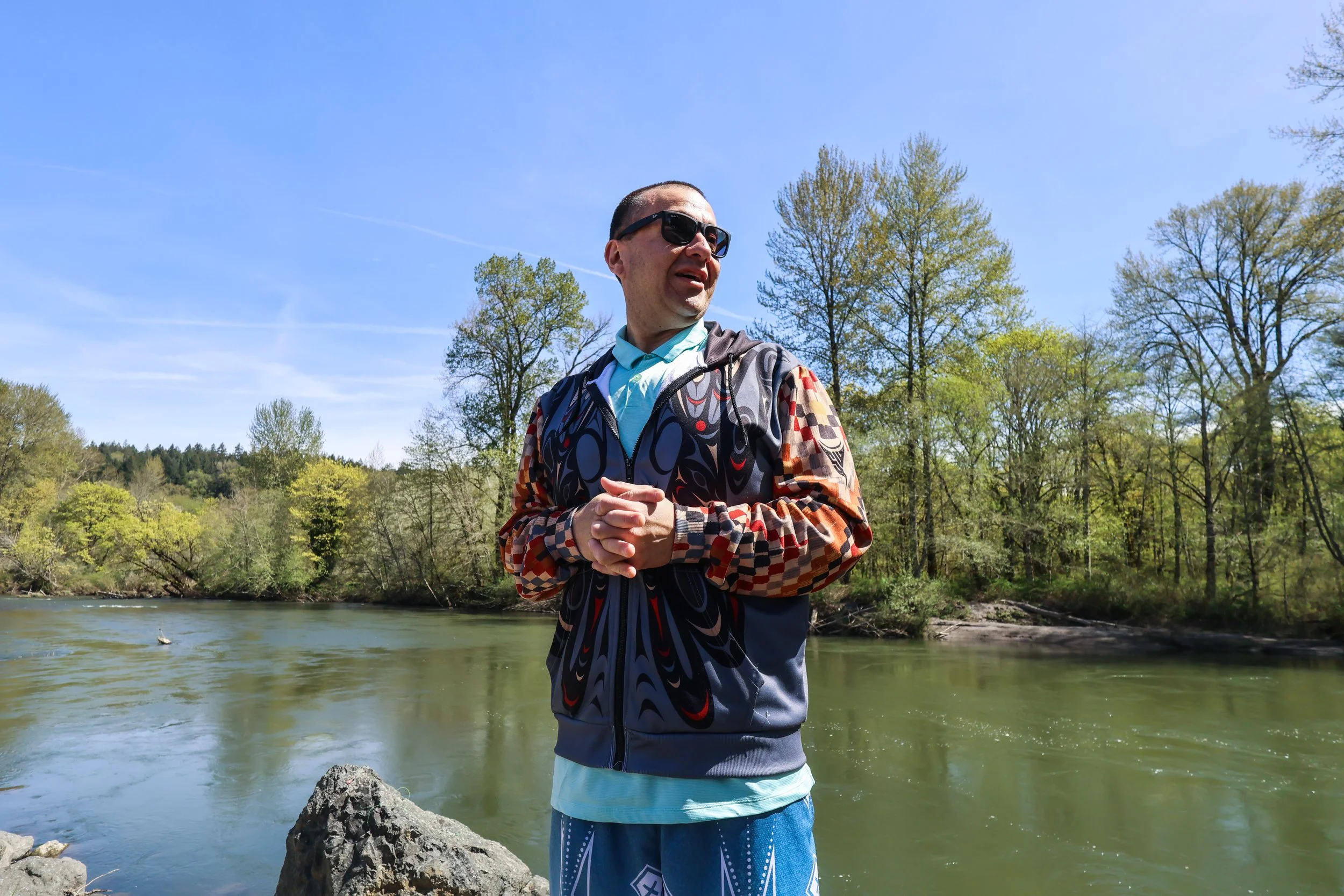
Willie Frank III, 44, stands along a part of the Nisqually River outside of the tribe’s reservation. He shares stories of his father fishing along the bank of the river and being arrested multiple times during his historic fight for fishing rights. 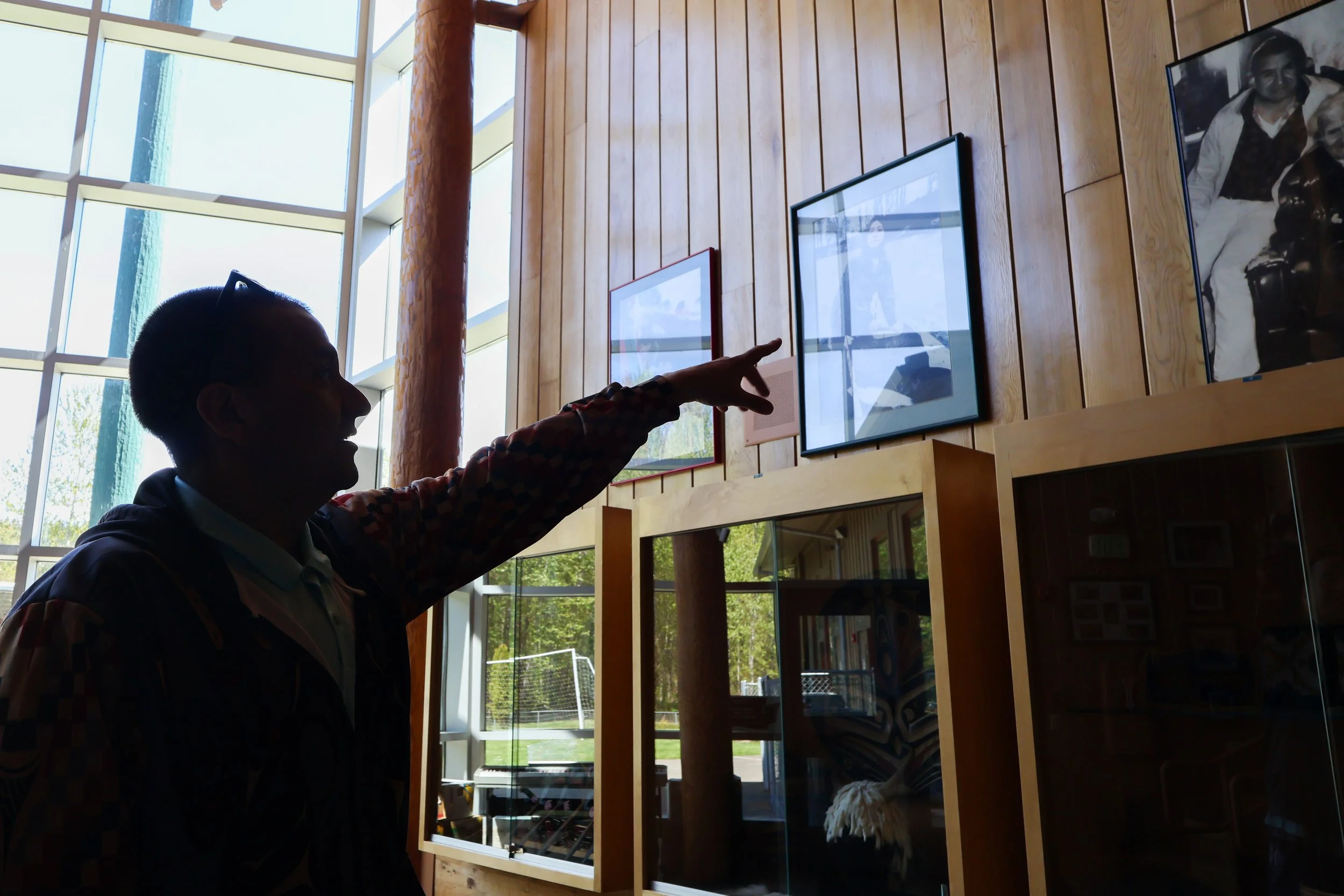
Willie Frank III recognizes himself in a photo as a little boy sitting with his father and grandfather. The photo hangs above various cultural Nisqually items in the tribe’s school.
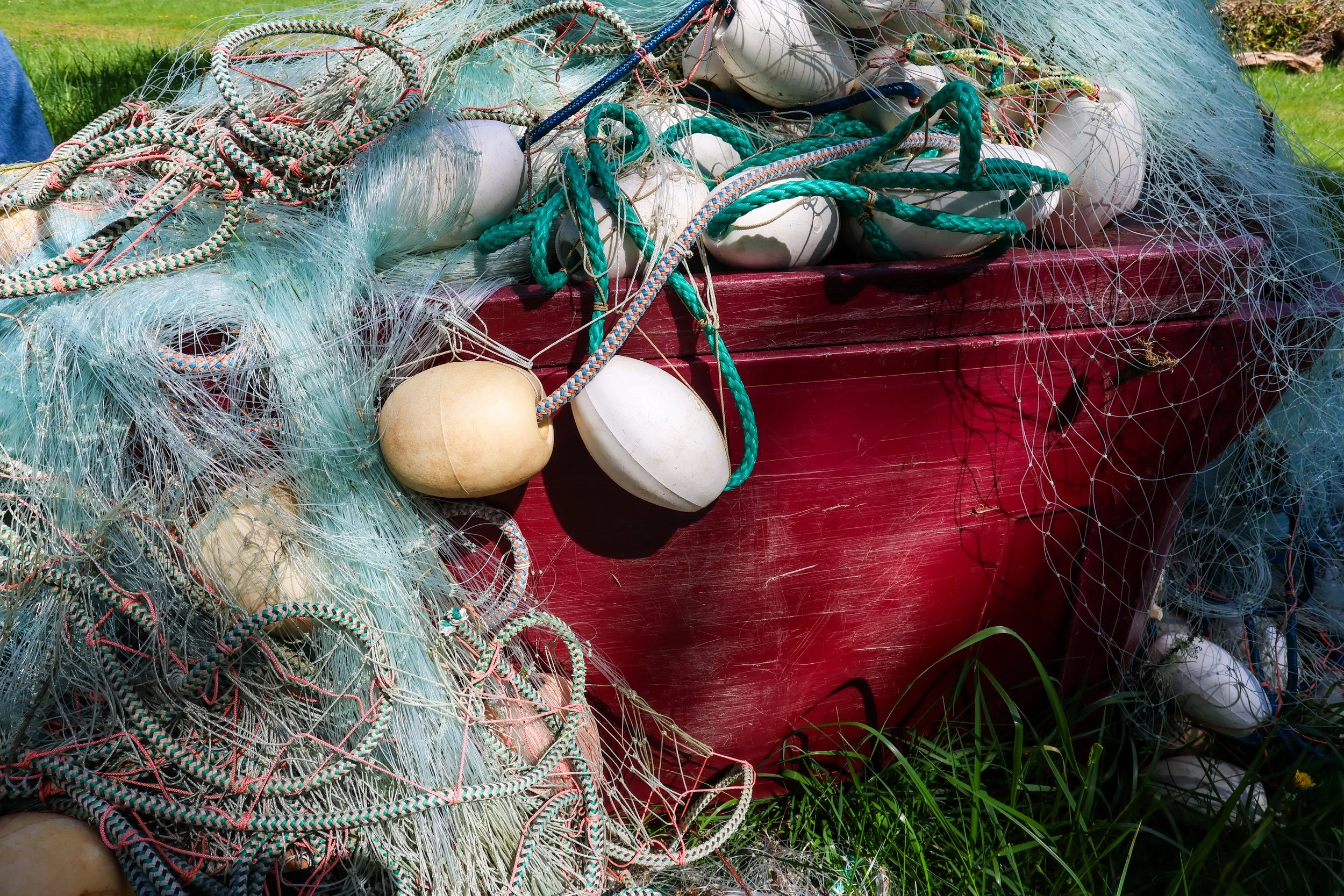
Fishing and boating equipment, including buoys tangled up in nets, are sprawled along the shore of the Nisqually River.
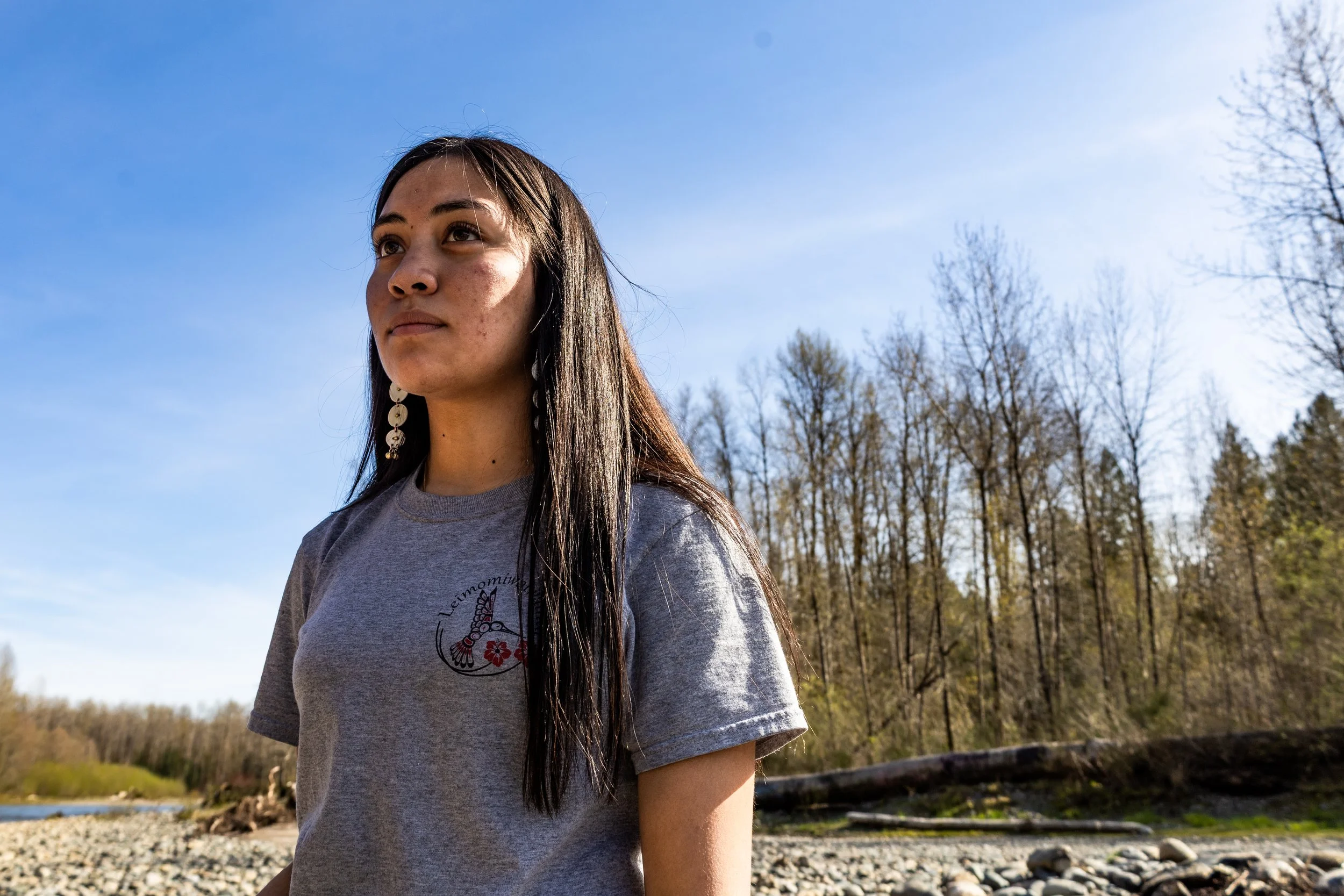
Mehanna McCloud, 16, stands and looks out at her cousins as they talk and laugh. She finishes praying and tosses the remaining cedar stems into the river.
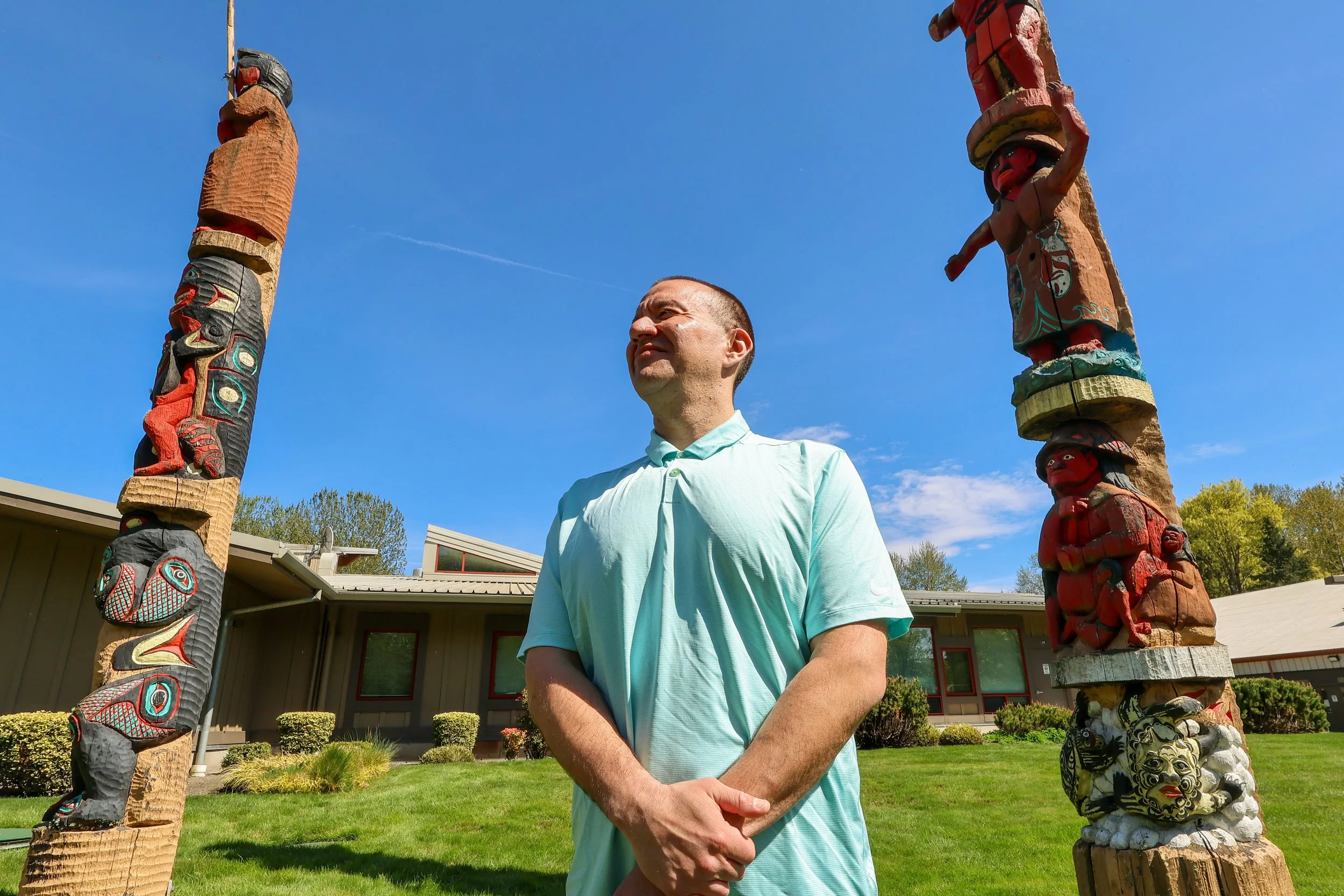
Willie Frank III, 44, stands between two sculptures that welcome students into the Wa He Lut Indian School. One shows animals that hold symbolic meaning to the tribe, while the other depicts different roles tribe members carry out. They show the circle of life and how both people and their environment work together.
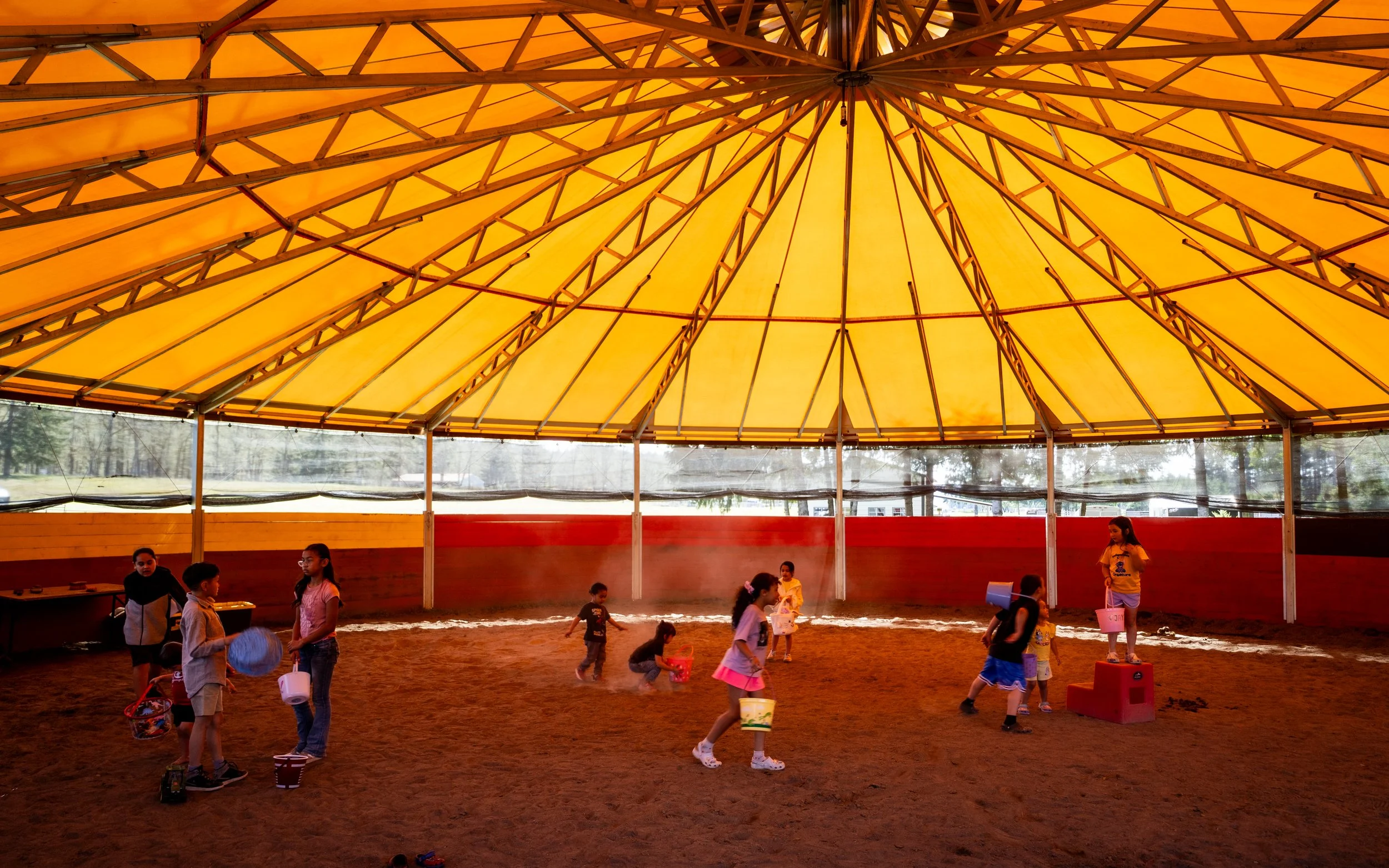
After the canoe reawakening ceremony ends, the youngest children are antsy and go to the horse pen on Medicine River Ranch to run around and play.
This makes them especially susceptible to the effects of climate change. Warmer summers and drier winters mean more melt than growth, leading to glacial retreat at the toe of the mass.
For glaciers in the Pacific Northwest, this retreat is occurring swiftly.
Mount Rainier has lost 42% of its glacial area over the last 125 years, according to a 2023 National Park Service report.
Water from glacial melt warms as it descends the mountain, jeopardizing salmon spawn; killing off the eggs before they’re able to hatch. In 2014, water temperatures in the Nisqually River reached a record 70 degrees, 30 degrees higher than the ideal summer temperatures, according to the U.S. Fish and Wildlife Service.
In the wake of warming waters, Puget Sound steelhead suffered a 90% population decline in the 1990s and the fall Chinook were deemed an endangered species, according to the Nisqually Land Trust.
“I worry about the water and the snow cap on Mount Rainier,” Frank III said. “Every year it gets less and less. Working with one of our historians, he scares the hell out of me every time, man … he’s not trying to scare me, but what are we gonna do?”
Up the road from the Nisqually River, on Frank’s Landing, Frank III looks up at his father’s canoe, hung in the rafters of the Wa He Lut Indian School. Next to the boat is a photo of him, his father and his grandfather.
He strives to follow in his father’s footsteps, advocating for youth involvement with the tribe and teaching the importance of cultural identification.
“The mindset was assuring that our children could learn their culture, learn their way of life, and live in the best and worst of both worlds, hopefully,” he said.
The Frank family’s efforts are not confined to the Pacific Northwest — the ripple has reached Washington, D.C. A statue of Billy Frank Jr. will be erected at the National Statuary Hall Collection in March 2027. The plaque, representing Washington state, will say “Tell your story” in Lushootseed.
“I think about that statue being in the United States Capitol and having our language there forever,” Frank III said.
After years of eroded heritage, Frank III thinks it’s finally time to reclaim their Nisqually roots.
“Before, I didn’t believe we were ready; now, with the statue coming and the reawakening of the language, I believe that it’s the right opportunity to heal our people,” Frank III said.
On the same land where Leschi was hanged, renewed spirits have arisen 168 years later. Yet, looming above the lands, their mother of waters weeps.
Nisqually members like Mehana McCloud embody the youthful spirit. At 16, she is involved in many Nisqually traditions. She is helping revive Lushootseed, learning to skipper their canoe, practicing traditional weaving and working at the horse ranch.
McCloud wants to carry these traditions onto the next generation. “It’s [about] helping people that didn’t have the opportunity that I was given,” she said.
After the awakening ceremony wraps, the group begins the return process.
McCloud ferries a crew of Nisqually youth in the back of her pickup, along with the bucket of Nisqually river water and cedar branches, to the riverbed.
The water spills over the side of the truck as McCloud barrels over potholes and winds through forested roads.
At the riverbank, McCloud directs her crew to the shore, each bearing a handful of cedar boughs. They say a prayer and begin the return process by casting the branches into the current and restoring the water to its home.
This process is about returning what they take from nature. This is how they repay Tahoma.
“None of the water, none of the salmon, the deer, the elk, anything that the creator gives us is ours,” Frank III said. “We’re just here, and we’re the messengers at this time. We’re witnesses to this time.”
Tradition holds the land together, while the land holds the Nisqually together. For the youth, glacial melt reshapes their waters. Yet, their customs are still passed on, keeping their culture alive.