


Trash to Treasure
-
![]()
Ryan Singer, 21, wears a pair of selvage denim 937-model Levi reproduction jeans, which were made in 1998. Singer bought the jeans three years ago.
-
![]()
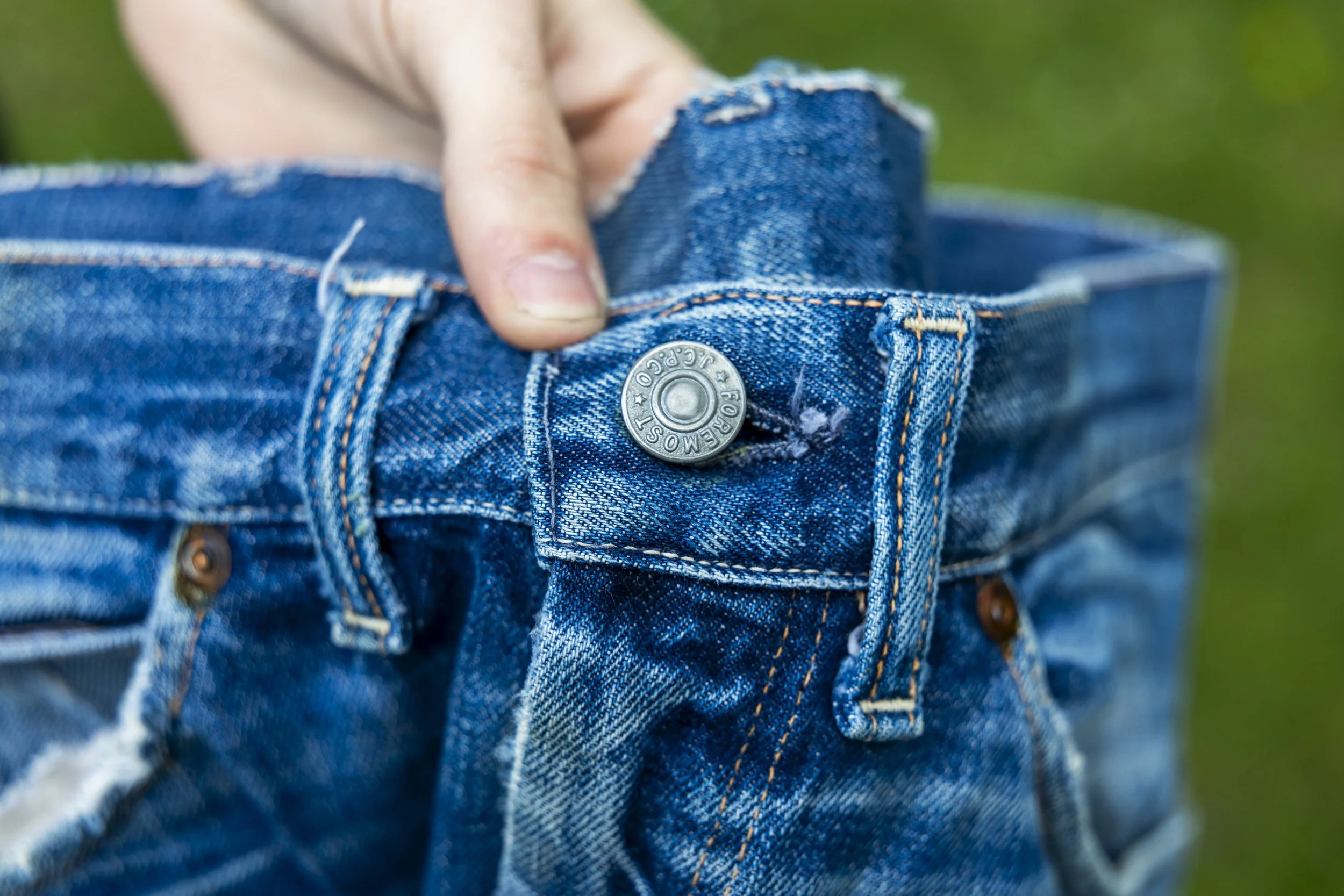
A button on a pair of 1998 JCPenney jeans, made in Japan, half-selvage, owned by Ryan Singer, 21, which are half-selvage. Half-selvage is when only one of the two outseams on a pair of jeans is constructed through a tightly woven self-edge, otherwise known as selvage, while the other outseam is constructed by a standard lock-stitched seam.
-
![]()
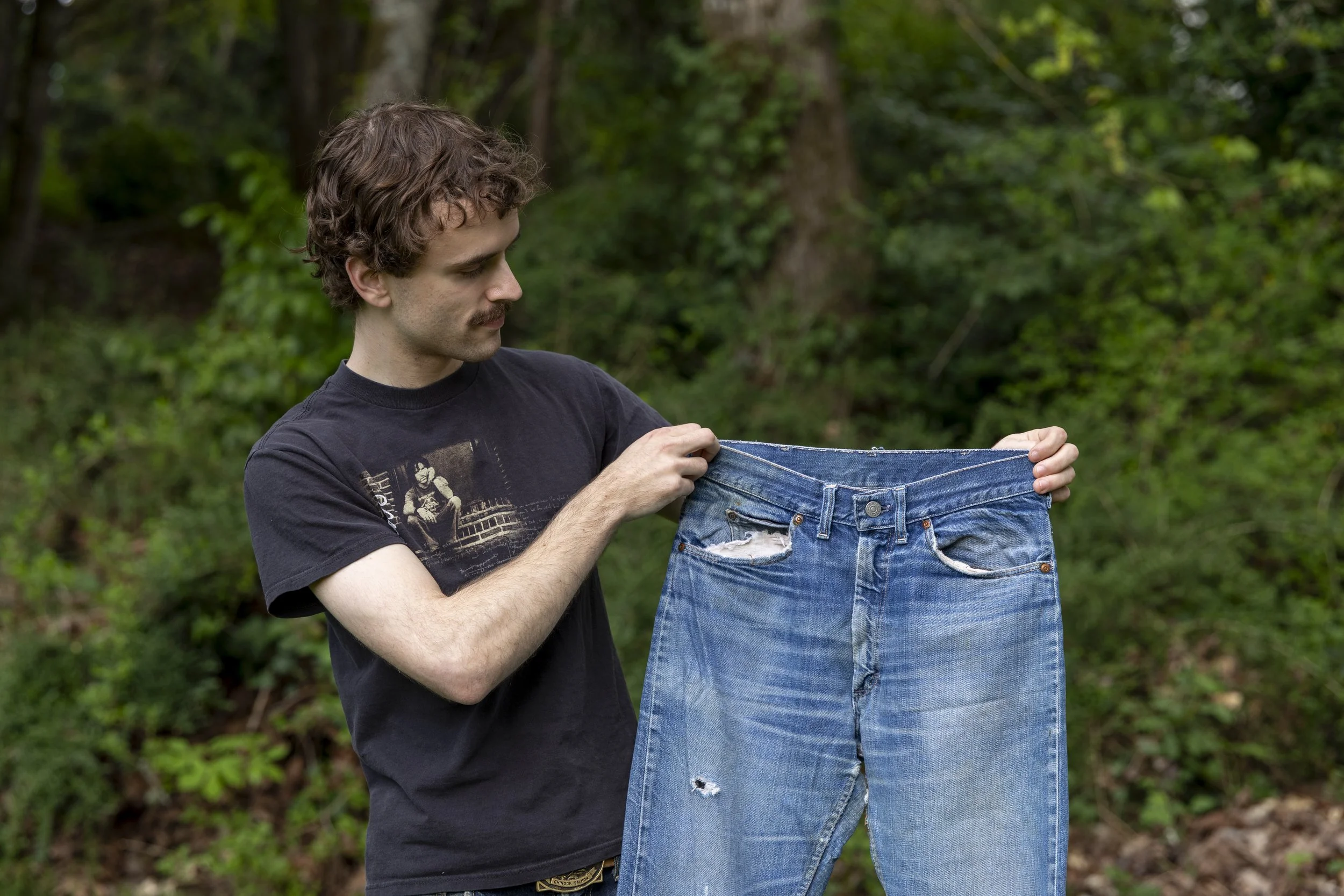
A pair of 1998 JCPenney jeans, made in Japan, which are half-selvage. The jeans, found by Ryan Singer, 21, were in a house, wrapped up in a paper grocery bag. The jeans have whisker fading, a high-contrast effect seen on unwashed or raw denim.
-
![]()
Ryan Singer, 21, wears a post-war ‘40s or ‘50s JCPenney Big Mac salad-and-pepper jacket in Washburn Park in Eugene, Ore. He also wears a pair of 1937-model Levi's selvage denim jeans. Singer found this jacket in the attic of a makeshift workshop. The jacket was acting as insulation in the workshop, and has two cinches on the back with a mixture of original repairs and repairs that Singer has done to make the jacket more wearable.


-
Driving through Oregon's winding back country, Ryan Singer anxiously rehearses his pitch.
(Hi, my name's Rayn, and we’re going around looking to buy old clothes)
It’s not a sales pitch,-- but rather, a buying pitch.
00:16 "Yeah, confidence is key, after the first few, usually I get into the groove."
For nearly three years, 21-year-old Singer has been doorknocking, asking permission to search through abandoned properties. He's looking for old clothes — in the walls, the attics, and put away in dusty boxes.
–
Singer didn't start with abandoned houses; he started at the Goodwill outlet. It wasn’t long before he started skipping class to spend hours digging through musty clothes.
Soon after, he got access to his first abandoned house.
0026 (6:00):
Much of the time, he's finding clothing from the 80s and 90s — stuff you'd see in your mom's closet.
But what he's really looking for is 'true' vintage, clothes that are 50 years or older. But for Singer to get to the clothes, he has to first go through the property owners.
(0020, 1:05-1:17): "Half the battle is convincing them I'm not crazy, which I might be crazy for being out here looking for jeans with holes in them, but ya know it is what it is, it’s part of the battle ."
The process involves hours of driving, weeks of searching for abandoned houses on Google Maps and a whole lot of rejections.
[Walking b-roll on gravel.]
Walking up to an unkept house with a pickup truck parked next to it, Singer realizes the door is boarded up and might not have to recite his buying pitch. Just in case, he knocks on the door anyways.
(Car door closing and opening, jingling of keys, walking on gravel. Knocking of the door.)
“Who is it?”
“Hey, my name’s Ryan. We’re looking to buy old clothes today.”
“You’re looking to buy what?”
“We’re looking to buy old clothes, we’re vintage clothing dealers, we’re looking for old jeans and stuff like that.”
“Oh, get gone!”
“Ok… have a nice day, sorry sir.”
Most of Singer's days door-knocking are filled with interactions like this — denial and judgment from some of Oregon's most isolated residents.
(0020, 00:12-00:25): "People don't understand at all that this rotting away building has thousands of dollars; we're having to form that connection in their mind."
(00:20)" Like if I was going door to door and being like 'hey, I see you have a classic car out here in the driveway, I collect classic cars. I wanna give you an offer on that car. Are you looking to sell the car? I’ll give you $13,000 or whatever,”: they understand immediately, like this guy is a collector of classic cars, I understand, I’m gonna hear what he has to say. But if I'm like 'I wanna buy your old jeans,' people would be like 'What is this guy smoking?'"
Usually, Singer has to overcome both physical barriers like gates and guard dogs, and interpersonal barriers like hesitant homeowners .
And that's before he even gets into a house.
..
0026 (4:50–5:00): "That house is old as shit though, oh my god."
Entering a house overgrown with ivy and missing a front door, Singer carefully dodges empty containers and listens for any wild animals upstairs.
Every trip Singer has gone on has challenged his sense of smell, and also his anxiety.
Even though he has a painter's mask and latex gloves, he’s still very aware of the risks of inhaling mold and rat poop or even falling through the floor of a decomposing house.
((gravel walking sound into a successful house))
But for him, it’s all worth it for that diamond in the rough.
Getting in-house.wav: 10:45–15:15
..
Singer still remembers his best pick. He found it on a whim, near the side of the road. He spotted a detail on the cuff of a pair of Levi's, and immediately knew he had uncovered some forgotten vintage relics.
0026 0:10-0:25 (28 seconds): "My best pick — I ever hit the house, we saw the levis and pulled over off the side of the road. The house was like that, close to the road, and there was a Levi's leg just hanging out. I could see the selvedge from the road. You can't make this up."
The detail was a selvedge identifier, a marker of high-quality jeans. This small, easily overlooked section of denim is sewn into itself on the inside of the jeans to prevent fraying.
After 1984, Levi's largely stopped using selvedge, making it even more valuable today. In this case, the jeans were from 1947, making them worth thousands.
The house was stuffed. He found ten pairs of the same model.
0017 (2:05-2:36)“Like, it's going to be out here in a spot that people like, haven't been, you know, and old houses and cities and stuff, the owners change and they get cleaned out. But out here, time kind of stands still, and you can find stuff that's honestly been forgotten about.”
Most people drive by abandoned houses without a second thought, but Singer doesn't. Three years later and he's still mapping out routes, reciting his pitch in the boonies of Oregon.
0026 (5:10–5:41): "I guess I just know, I guess I have past experiences driving me — the feeling of opening a box and seeing blue and then like realizing it's like 20 pairs. Once you've had that experience, it's pretty insane. Honestly, not many feelings compare to that. And maybe I'm just insane, but it takes the right type of person to be interested in this."
Singer is that person.
He says he wants to be a trashman after he graduates college this year… he’s kinda joking, but not really. That’s his dream: collecting one man’s trash and turning it into another’s treasure.
For FLUX Magazine, I’m Leo Heffron.
Ryan Singer finds value where many don’t, in the crumbling houses